📌 Quick Summary: The Ganges River Dolphin (Platanista gangetica) in Nepal
- Local & Scientific Name: Platanista gangetica, locally known as the "Susu" in Nepali (named after the sharp breathing sound it makes at the surface) and "Soons" among indigenous Tharu and Sonaha river communities.
- IUCN Status & Nepal Population: Listed as Endangered on the IUCN Red List. Fewer than 50 wild individuals survive in Nepal's river systems today.
- Last Strongholds in Nepal: The Karnali and Geruwa river system bordering the western edge of Bardia National Park (Nepal's primary breeding sanctuary) and the Sapta Koshi river basin in eastern Terai.
- Unique Evolutionary Adaptation: An obligate freshwater cetacean that is essentially blind (lacking a crystalline eye lens), swims on its side, and hunts 24/7 using a hyper-specialized biological sonar (echolocation).
- Best Time to Spot Them: October to November (high post-monsoon waters) and February to May (dry season when dolphins concentrate inside deep permanent pools of the main Karnali channel).
When travelers picture a wildlife safari in Nepal, the first images that come to mind are usually the Royal Bengal tiger padding silently through towering elephant grass, the greater one-horned rhinoceros emerging from morning river mist, or giant wild Asian elephants. Yet beneath the turquoise, silt-laden waters rushing down from Himalayan glaciers into the subtropical Terai plains lives one of the rarest, most ancient, and most extraordinary mammals on Earth: the Ganges River Dolphin (Platanista gangetica).
A true "living fossil" whose evolutionary lineage diverged from oceanic dolphins more than 24 million years ago during the Miocene epoch (when the ancient Tethys Sea still flooded the Indo-Gangetic basin prior to the final uplift of the Himalayas), this obligate freshwater cetacean now clings to survival in a handful of free-flowing South Asian rivers. In Nepal, the mighty Karnali River—forming the western boundary of Bardia National Park—represents its purest and northernmost wilderness sanctuary on the planet.
1. What Is the Ganges River Dolphin? Portrait of the "Susu", the Blind Cetacean of the Himalayas
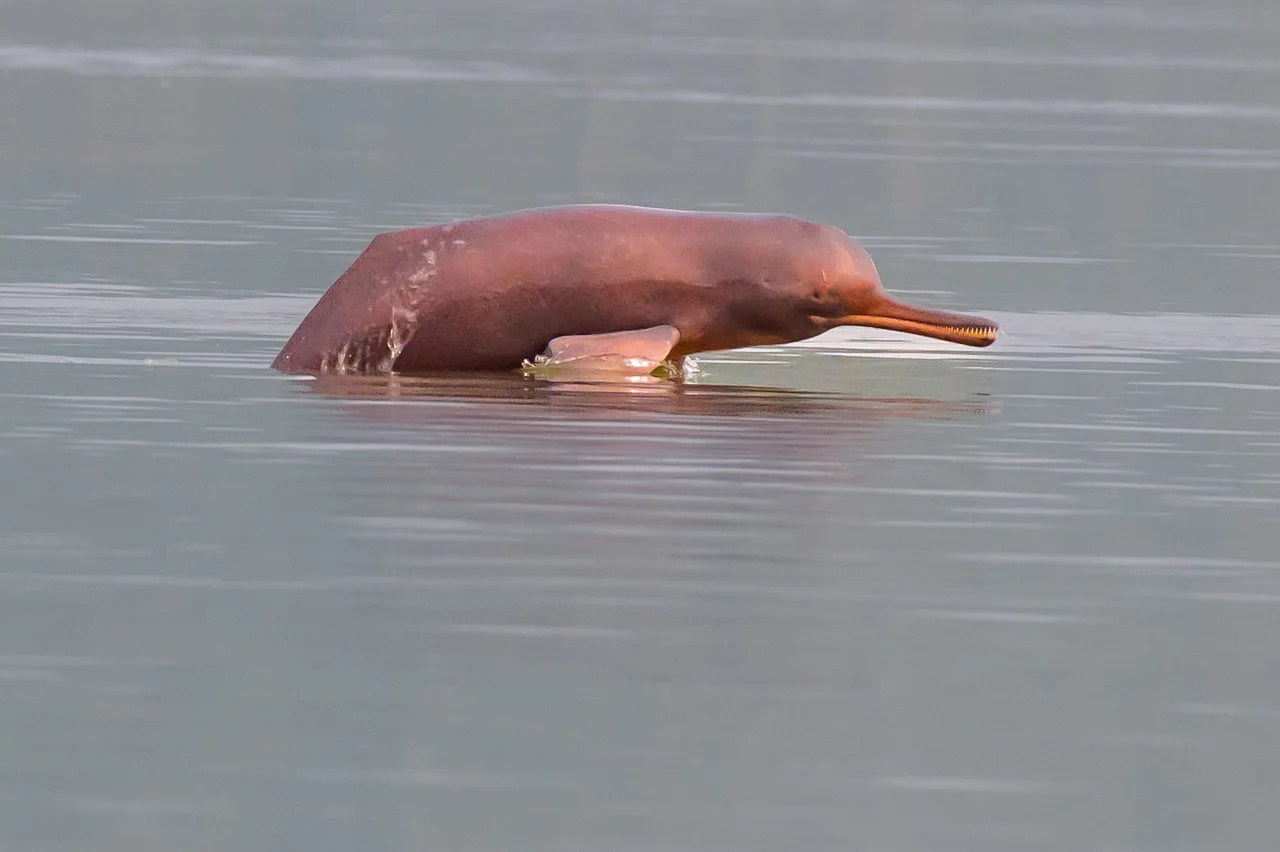
Unlike marine bottlenose or spinner dolphins, the Ganges River Dolphin belongs to an ancient, distinct zoological family (Platanistidae). Over millions of years, it has evolved astonishing anatomical adaptations to thrive in Himalayan rivers heavy with glacial silt, sand, and organic sediment where underwater visibility is often less than ten centimeters.
Why Is It Called the "Susu"?
Like all aquatic mammals, the Ganges River Dolphin must rise to the surface regularly to breathe air through its longitudinal blowhole located atop its head. It dives for an average of 30 to 120 seconds before slicing through the surface in a fleeting, graceful arc lasting barely one to two seconds. As it forcefully exhales and inhales at the surface, its blowhole produces a crisp, unmistakable sneezing sound: "Soo-soo!". This acoustic signature gave rise to its local name, Susu, across Nepal and northern India. During a silent river rafting safari on the Karnali, our native trackers frequently hear the dolphin's breath echoing off the riverbanks before spotting the ripple of its dorsal ridge!
A Blind Dolphin That "Sees" With Sound (24/7 Echolocation)
In the sediment-rich waters of the Karnali, Geruwa, and Koshi rivers, eyesight is virtually useless. Over evolutionary time, the eye of the Ganges River Dolphin regressed to the size of a pinhole and completely lost its crystalline lens. The dolphin cannot form visual images; its retinas merely detect the presence and direction of sunlight, helping it distinguish the bright river surface from the dark riverbed below.
To compensate for blindness, Platanista gangetica relies on one of the most sophisticated biosonar systems in the animal kingdom. Its rounded forehead (the "melon") houses specialized acoustic fat deposits framed by two unique bony maxillary crests on its skull that act like an acoustic megaphone. Unlike oceanic dolphins that click intermittently, the Ganges River Dolphin emits continuous echolocation click trains 24 hours a day, painting a real-time 3D acoustic map of submerged tree roots, shifting sandbars, and bottom-dwelling fish.
Side-Swimming Locomotion and a Forceps-Like Snout
Several anatomical traits make the Ganges River Dolphin immediately recognizable to wildlife enthusiasts:
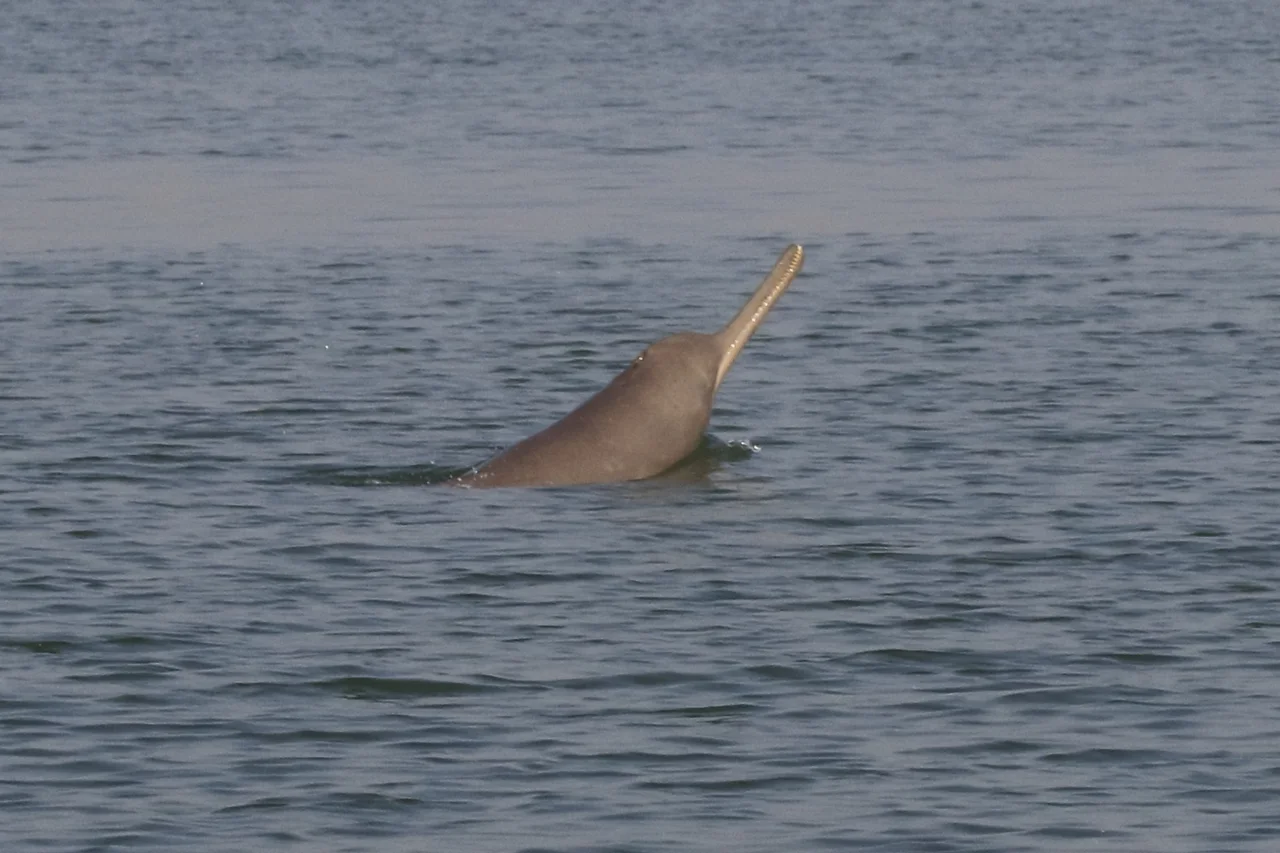
- A Toothed Forceps Rostrum: Its slender snout (rostrum) accounts for nearly 20% of its total body length and is lined with 28 to 35 sharp interlocking teeth on each side that remain visible even when its jaws are closed. Mature females grow noticeably larger than males—reaching 2.4 to 2.6 meters (80 to 90 kg) compared to 2.0 to 2.2 meters in males—and possess a longer, slightly upturned rostrum.
- A Flexible Neck: Unlike almost all oceanic dolphins whose cervical vertebrae are fused for high-speed hydrodynamic swimming, the 7 neck vertebrae of the Ganges River Dolphin remain unfused. This allows the dolphin to turn its head side-to-side and downward as it probes muddy crevices along the river bottom!
- Side-Swimming Behavior: In shallower river channels, it swims tilted at a 90-degree angle on its side (usually its right side), trailing its broad, paddle-like pectoral flipper along the muddy riverbed to flush out catfish, carp, and freshwater prawns while maintaining constant tactile orientation.
2. Field Comparison: Ganges River Dolphin vs. Nepal's Other River Giants
From a distance along the riverbanks of the Terai, travelers occasionally confuse the brief surface roll of a Ganges River Dolphin with a Gharial crocodile or a family of smooth-coated otters. Here is how our naturalists distinguish them in the field:
| Field Feature | Ganges River Dolphin (Platanista gangetica) | Gharial Crocodile (Gavialis gangeticus) | Smooth-Coated Otter (Lutrogale perspicillata) |
|---|---|---|---|
| Adult Size & Weight | 2.0 to 2.6 m • 70 to 90 kg | 3.5 to 5.5 m • 160 to 450 kg | 1.1 to 1.3 m • 7 to 11 kg |
| Surface Behavior | Brief 1–2 second rolling arc every 30–120 seconds accompanied by a sharp "Susu" breath. Never hauls out on land. | Floats motionless at the surface (only eyes and nasal tip visible) or basks for hours on sunny sandbanks. | Swims in noisy family romps (5–12 individuals), porpoising and frequently climbing onto sandy banks and driftwood. |
| Visual Silhouette | Chocolate-brown to greyish-buff smooth skin, low triangular dorsal ridge (no tall curved fin), long needle-like rostrum. | Long flat jaws with 110 teeth, armored dorsal scutes, bulbous nasal boss (ghara) on adult males. | Sleek velvety brown fur, rounded head with thick whiskers, flattened muscular tail. |
| Estimated Nepal Population | < 50 individuals (IUCN Endangered) | ~250 individuals (IUCN Critically Endangered) | Several hundred (IUCN Vulnerable) |
| Prime Location in Nepal | Karnali River (Bardia) & Sapta Koshi | Rapti & Narayani Rivers (Chitwan) and Karnali / Babai (Bardia) | Karnali / Geruwa River channels (Bardia) |
Track the Ganges River Dolphin by Silent Raft on the Karnali (190€)
Drift silently down the pristine Karnali River from Chisapani Bridge with our river captain and senior naturalist guide: spot wild Ganges river dolphins, gharials, otters, waterbirds, and tigers along the riverbanks.
3. Where to See the Ganges River Dolphin in Nepal: The Last 2 Sanctuaries
Historically, the Ganges River Dolphin inhabited all four of Nepal's major trans-Himalayan river systems: the Mahakali (far west), the Karnali (west), the Narayani / Gandaki (central Nepal, flowing along Chitwan National Park), and the Sapta Koshi (east). Today, due to cross-border irrigation barrages that block seasonal upstream migrations, only two river systems still sustain resident populations in Nepal.
1. The Karnali and Geruwa River Corridor (Bardia National Park)
For wildlife lovers seeking an untouched wilderness setting, the Karnali River is the undisputed crown jewel. Where the Karnali bursts out of the Siwalik mountain gorges beneath the iconic cable-stayed bridge at Chisapani, it splits into two braided channels embracing the western flank of Bardia National Park: the main western Karnali channel and the eastern Geruwa branch, joined further south by the Mohana River.
Why is the Karnali such an exceptional refuge for the Susu? Because it combines oxygen-rich riffles with deep, slow-moving counter-current pools (eddies) carved where secondary channels and pebble islands meet. Our native trackers know the exact deep pools favored by resident dolphins throughout the year:
- Downstream from Chisapani Bridge: Where the river widens after exiting the rocky gorge, forming deep emerald pools teeming with Golden Mahseer.
- The Confluences of Kothiaghat, Patabhar, and Lalmati: Deep counter-current eddies where swirling waters trap schools of prey fish.
- The Southern Tributaries (Mohana, Pathariya, and Kandra in Kailali District): During the monsoon and early post-monsoon (through October and November), mothers and calves move into these calmer tributary streams to feed away from heavy main-stem currents.
2. The Sapta Koshi River (Koshi Tappu Wildlife Reserve, Eastern Nepal)
In the far eastern Terai plains, the Sapta Koshi River shelters Nepal's second population (estimated at 15 to 25 individuals), mostly sighted upstream and downstream of the Koshi Barrage adjacent to Koshi Tappu Wildlife Reserve—famous for its wild water buffalo (Arna) and 500+ bird species. While Koshi offers reliable roadside viewing near the barrage, drifting down the wild Karnali River in Bardia—surrounded by primary Sal forest with Bengal tiger pugmarks on the sandbars—delivers a far more immersive wilderness experience.
4. How We Track the Ganges River Dolphin Ethically in Bardia
Featured prominently in our guide to the rarest animals to spot on a Nepal safari, the Ganges River Dolphin requires patience and zero acoustic disturbance. We use two complementary, 100% non-intrusive tracking methods:
Option A: Silent Paddle Rafting on the Karnali River (1-Day or Multi-Day Expedition)
We never use motorized boats: underwater engine noise blinds a cetacean that depends entirely on echolocation to navigate and hunt. On our full-day Bardia Rafting Safari (or our flagship 18-day Karnali River Rafting & Wildlife Expedition), we launch beneath Chisapani Bridge aboard a silent paddle raft guided by a licensed river captain and senior naturalist tracker.
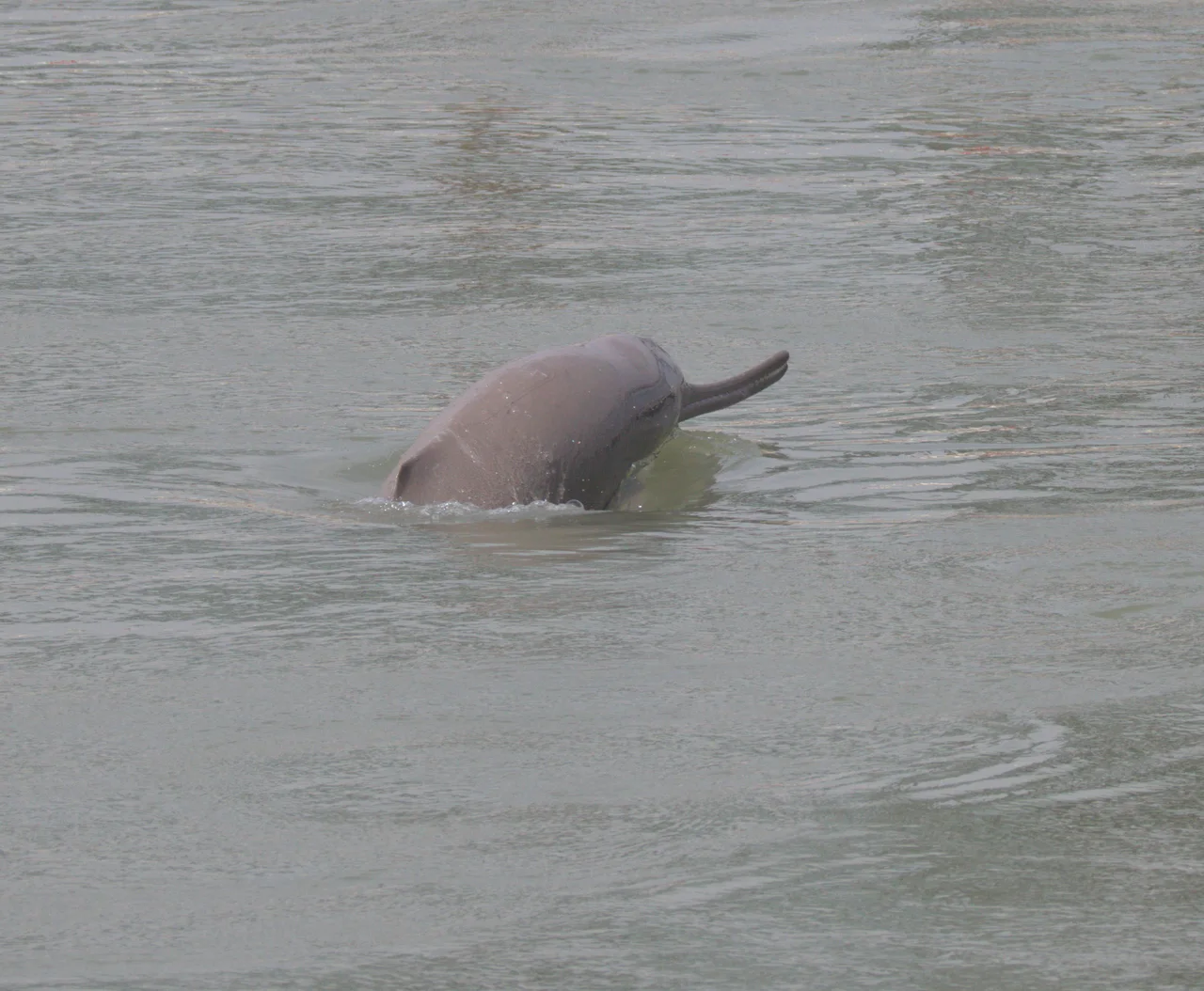
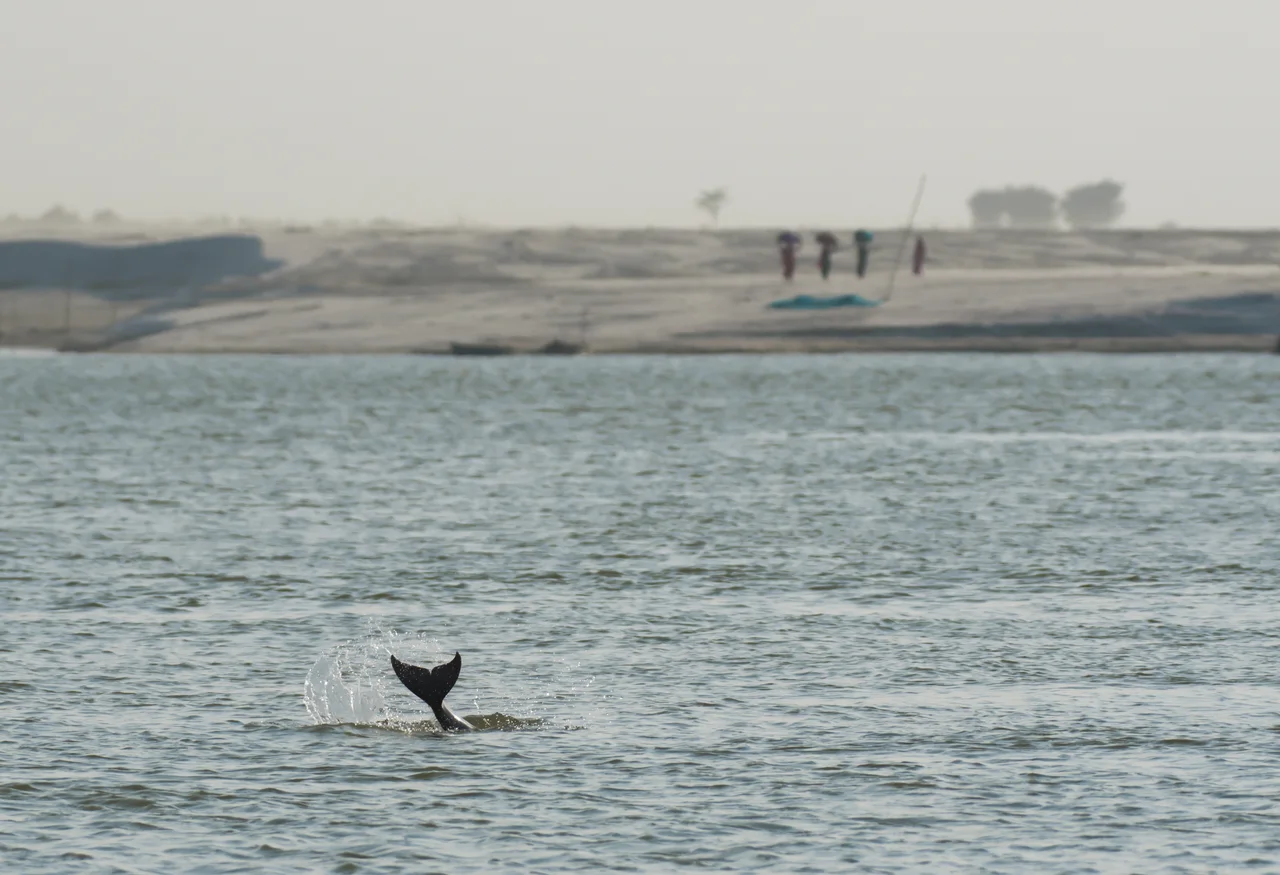
As we approach deep eddies known to hold Susus, our crew lifts all paddles and lets the raft glide in complete silence. When the river surface is glassy, the sharp "Soo-soo!" breath often echoes less than thirty meters away, followed by the coppery-brown arch of the dolphin's back and toothed rostrum slicing through the water.
Option B: High-Bank Spotting Scope Stakeouts on Foot
If you join one of our signature wildlife tours such as Bardia Tiger Safari (5 Days), Bardia & Babai Wild Camping (8 Days), or our intensive tracking expeditions, our master trackers (Pawan, Kiran, and Krishna) receive daily updates from indigenous Sonaha fishermen and park rangers regarding which Karnali pools the dolphins are actively patrolling.
We set up a quiet stakeout atop an elevated pebble bank with high-magnification binoculars right where a calm backwater meets the main current. Watching the current seam for 30 to 45 minutes reveals the rhythmic surfacing cycle of hunting dolphins—and occasionally a dramatic oblique leap clear of the water as a Susu chases surface fish!
5. Best Season and Time of Day to See the Ganges River Dolphin
Water levels dictate how and where dolphins move across the Karnali river basin (see also our full guide on the best time for a safari in Nepal):
- February to May (Dry Season / Spring — Best for Pinpoint Location): This is the most strategic window. As river levels drop and minor side channels shallow out, 100% of Bardia's dolphins retreat into the deepest permanent pools of the main Karnali channel. Because their habitat shrinks to specific deep bends and the water turns a clear emerald-turquoise, our guides know exactly which pools to scan. This is also the prime season for tracking Bengal tigers in Bardia!
- October to November (Post-Monsoon Autumn — High Water & Active Prey): Immediately after the monsoon, river volume is high and migratory fish are abundant. Dolphins are highly active around the confluences of the Mohana and Pathariya rivers as well as deep eddies below Chisapani.
- December to January (Winter): Sightings are very reliable in the main Karnali channel, though it is best to scan between 9:30 AM and 11:30 AM or late afternoon (3:30 PM to 5:00 PM) once morning river fog has lifted.
💡 Field Photography Tip from Our Bardia Trackers
Capturing a sharp frame of a Ganges River Dolphin is one of the ultimate challenges of a wildlife photo safari in Nepal because each surfacing roll lasts barely one second! Set your camera to high-speed continuous burst mode (minimum 1/2000s shutter speed, f/5.6 or f/6.3, Auto ISO) with a 100–400mm or 150–600mm telephoto lens. Rather than panning randomly across the river, listen for the first "Susu" breath, note the eddy line, and pre-focus 15 to 25 meters upstream along the current seam—the dolphin will almost always surface along that exact line 45 to 60 seconds later.
6. Why Fewer Than 50 Dolphins Survive in Nepal: Conservation & Threats
Strictly protected under Nepal's National Parks and Wildlife Conservation Act of 1973 alongside the Bengal tiger, one-horned rhino, and snow leopard, the Ganges River Dolphin faces three critical threats:
- Cross-Border River Barrages: The Kailashpuri (Girijapuri) Barrage, located in India just a few kilometers south of the Bardia border, acts as a one-way trap during the monsoon. Dolphins swept downstream through the floodgates during peak summer floods cannot swim back upstream into Nepal when the gates close in dry season, genetically isolating Bardia's resident sub-population.
- Reduced Dry-Season Flow in the Geruwa Channel: Since major floods in the 2010s shifted the main river discharge into the western Karnali channel, the eastern Geruwa branch (bordering Thakurdwara) becomes too shallow in spring, concentrating all dolphins into the western Karnali channel.
- Gillnet Entanglement & Overfishing Outside Park Boundaries: In unprotected southern buffer zones, monofilament gillnets pose an entanglement hazard for calves and deplete stocks of migratory prey fish like the Golden Mahseer.
By booking an ethical wildlife safari in Nepal with a locally rooted operator like Jungle Nepal Adventure, your park permit fees directly fund DNPWC river anti-poaching patrols and community-based conservation along the Karnali corridor.
Ready to Explore the Karnali River & Tiger Territory in Bardia?
Combine on-foot tiger tracking, silent Karnali river drifting in search of the Ganges River Dolphin, and boutique eco-lodge stays with our native master trackers.
FAQ: Everything You Need to Know About the Ganges River Dolphin in Nepal
Can you see the Ganges River Dolphin in Chitwan National Park?
No, spotting a Ganges River Dolphin in Chitwan today is virtually impossible. Although the species historically inhabited the Narayani (Gandaki) River, it is now considered functionally extirpated on the Nepali side of Chitwan, with only one or two transient sightings reported per decade. To see wild river dolphins in Nepal, you must visit the Karnali River in Bardia National Park or the Sapta Koshi River at Koshi Tappu.
How many Ganges River Dolphins are left in Nepal in 2026?
Joint scientific surveys conducted by the Department of National Parks and Wildlife Conservation (DNPWC), NTNC, and WWF Nepal estimate Nepal's total population at fewer than 50 individuals (typically fluctuating between 35 and 52 dolphins depending on post-monsoon water levels), split between the Karnali/Mohana river basin in Bardia and the Sapta Koshi River in the east.
Is the Ganges River Dolphin completely blind?
Yes, its tiny pinhole eyes lack a functional crystalline lens, making it unable to form visual images. It senses only light intensity to orient itself toward the surface, relying instead on continuous 24/7 high-frequency echolocation clicks to navigate murky waters and hunt fish with pinpoint accuracy.
What is the best tour to see the Ganges River Dolphin in Bardia?
Our 1-Day Bardia Rafting Safari on the Karnali River launching from Chisapani Bridge is the most rewarding experience: you drift silently through the deepest river pools favored by resident dolphins while also spotting gharial crocodiles, smooth-coated otters, hornbills, and terrestrial wildlife drinking along the banks.
What time of day is best for spotting river dolphins on the Karnali?
Early morning (6:30 AM to 9:00 AM) and late afternoon (4:00 PM to 6:00 PM) offer the highest sighting success: wind speeds drop, the Karnali's surface turns glassy, and low-angle golden light makes it easy to spot surface ripples, long toothed rostrums, and the characteristic "Susu" breathing sound in deep river eddies.