Protecting Guides • Empowering Communities • Conserving Wildlife
In Bardia, independent local operator Jungle Nepal Adventure and the Nature Guide Association (NAGA) unite directly to provide occupational safety for jungle guides, preserve ancestral tracking skills, and foster lasting peace between apex predators and buffer-zone villages.
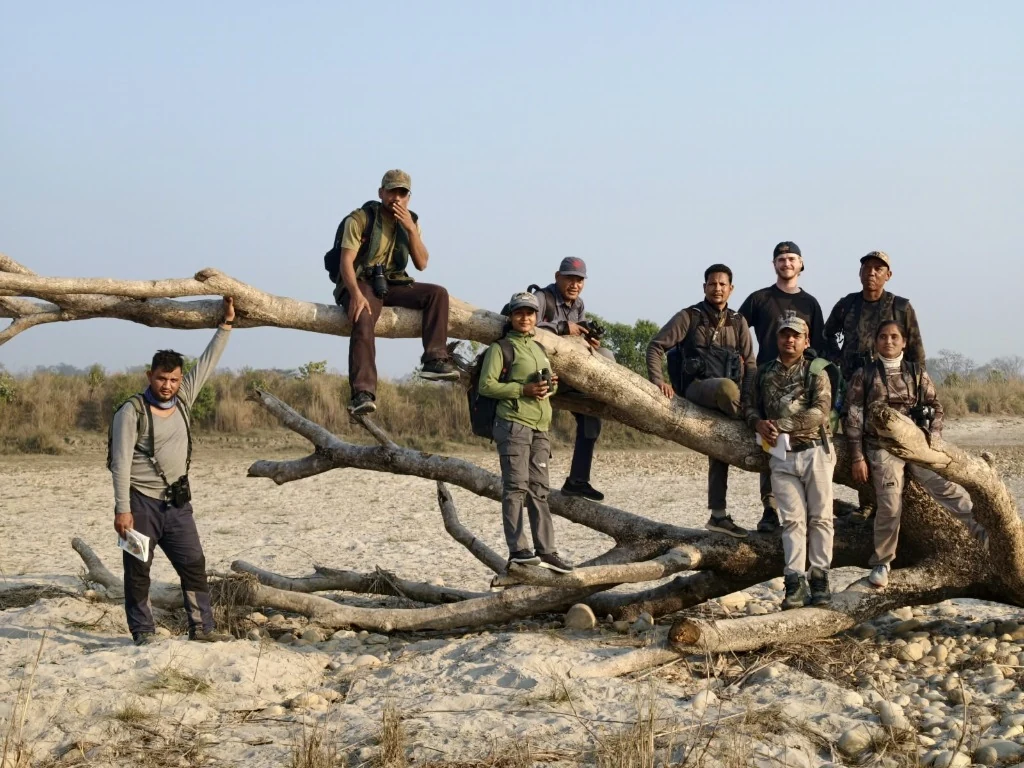
Founded in 1998 (2054 BS) in Thakurdwara, the Nature Guide Association (NAGA) unites and represents all certified naturalist guides and professional trackers officially licensed by Nepal's Department of National Parks and Wildlife Conservation in Bardia.
Chaired by Krisna Saha, it structures daily jungle walking safaris, mentors young local recruits, enforces wildlife safety rules in tiger habitat, and maintains an ongoing mediation bridge with buffer-zone communities.
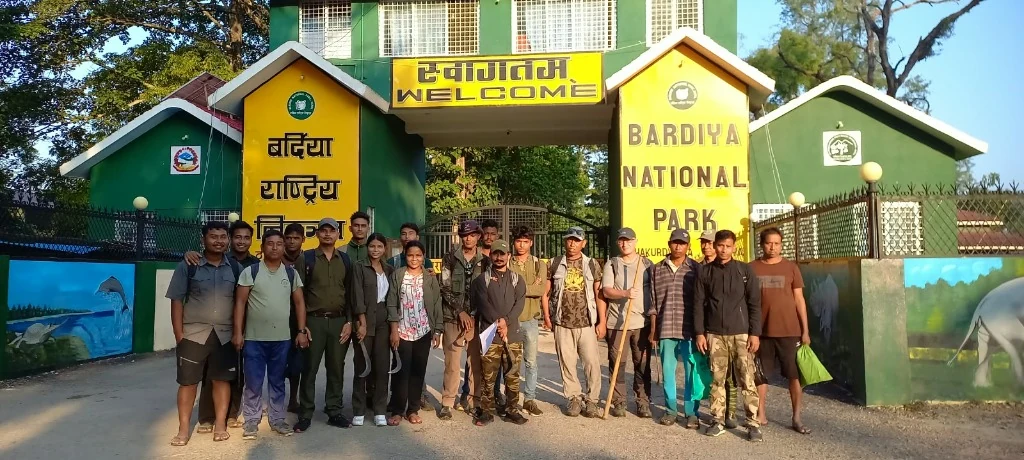
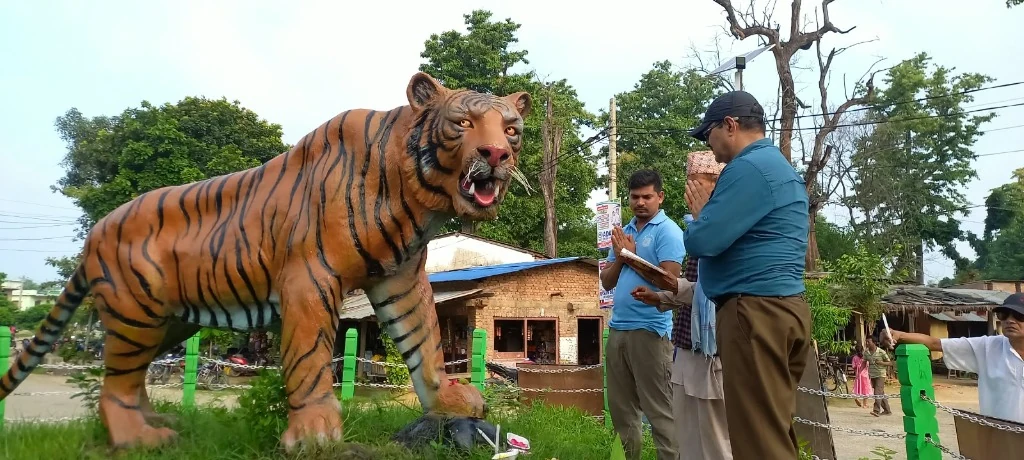
Official Bardia National Park Gate — Certified NAGA trackers and guides assembled before daily walking patrols in the forest.
Jungle Nepal Adventure was not founded in a remote corporate office, but directly on the soil of Bardia's wilderness alongside Pawan Thapa, Krisna Saha, and veteran local trackers. Our mission stems from firsthand hardships experienced in our own flesh.
In the deep jungle of Bardia, danger is not an abstract concept: Krisna Saha, current President of NAGA, survived a terrifying Bengal tiger attack during a forest patrol. Pawan Thapa, co-founder of Jungle Nepal Adventure, survived a severe fall from a tall tree while scouting wildlife. Most painful of all, a close friend and dedicated fellow guide was tragically killed by a violent one-horned rhinoceros charge.
These devastating experiences became an unforgettable turning point. Historically, when confronting animal charges or wilderness accidents, Bardia's nature guides had no safety net, no hospital coverage, and families were left alone burdened by medical debt. From this shared grief emerged an absolute necessity: the first, non-negotiable step is to build a full private insurance system protecting every guide in the association.
Jungle Nepal Adventure has made a formal commitment to donate a fixed contribution for every traveller joining our tours. Every guest contributes directly to the guides' protection fund with zero surcharge.
All contributions are channeled toward a clear, measurable goal: providing comprehensive private health & accident insurance to 100% of NAGA member guides. We aim to achieve this target by 2027.
In parallel, we supply emergency trauma kits (tactical tourniquets, haemostatic dressings) and provide emergency financial relief for guides' families during critical injuries or offseason hardships.
By joining a walking safari with Jungle Nepal Adventure, a fixed portion of your trip directly finances private insurance coverage for NAGA member guides. Our shared commitment: zero guides left unprotected in Bardia by 2027.
In Bardia, conservation goes far beyond celebration figures: with over 125 Royal Bengal tigers and thriving populations of one-horned rhinos and wild Asian elephants, daily coexistence for buffer-zone villages is under severe, unrelenting tension.
At night, wild elephant herds cross river channels to raid paddy fields and demolish mud homes to feed on grain reserves. Near forest boundaries, tiger and leopard incursions trigger tragic human losses among villagers collecting firewood or tending livestock. Recently, a fatal charge by a one-horned rhino claimed the life of a certified jungle guide on duty inside the park: real danger is an everyday constant.
Confronting this urgency, distant political speeches in Kathmandu or brief visits by NGO delegations cannot solve the struggle. We firmly believe that local jungle guides are the #1 actors and the best positioned to forge viable solutions: born in these buffer-zone communities, they share the families' grief while possessing the intimate understanding of wildlife behaviour needed to step in without panic.
Their core mission relies on continuous communication and grassroots sensitization: defusing anger after crop destruction to prevent retaliatory poisonings, teaching avoidance reflexes, and educating children in village schools to build lasting, peaceful coexistence.
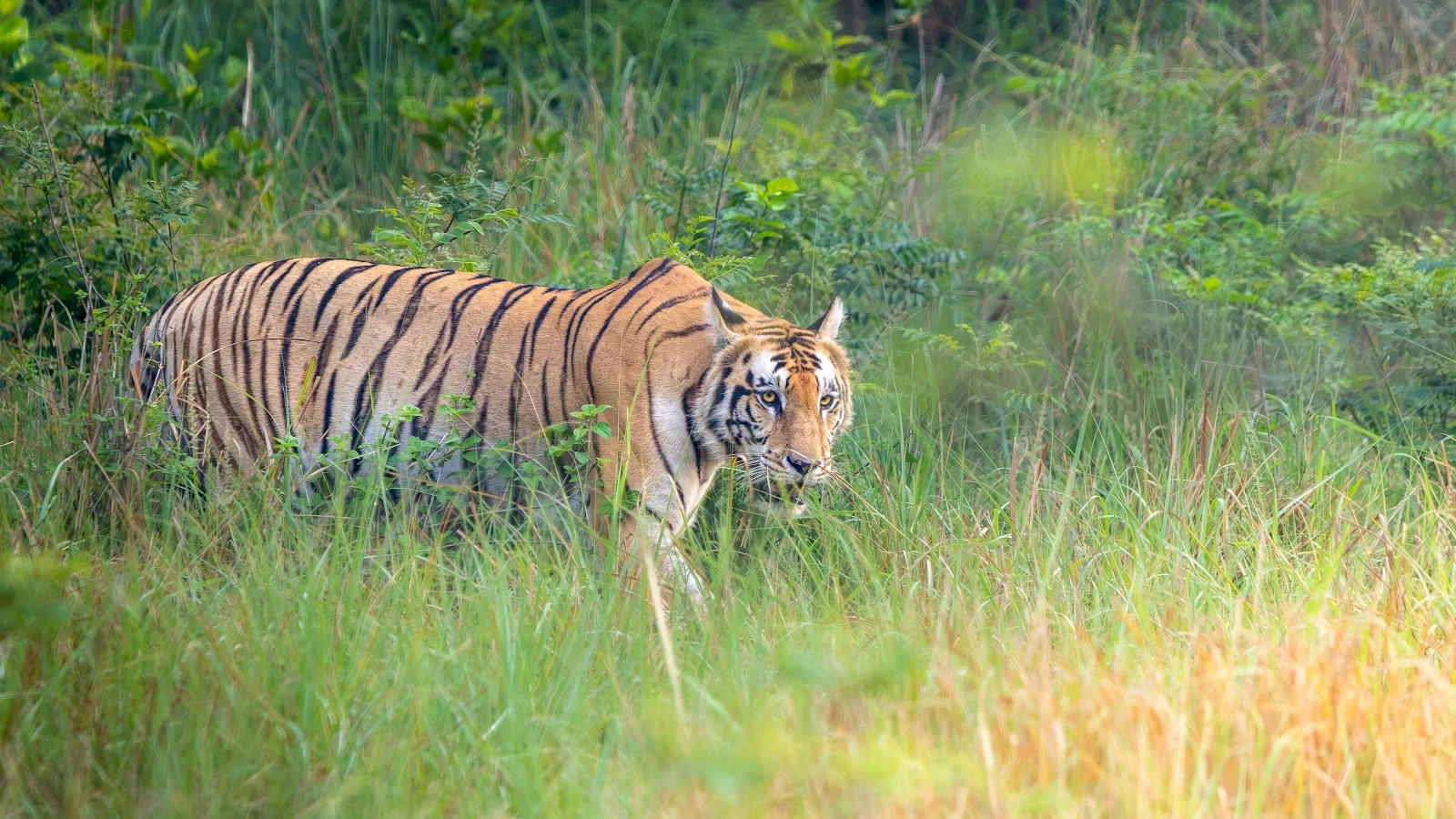
Royal Bengal Tiger in the Sal forest — In Bardia, jungle guides stand on the frontline to protect predators while safeguarding bordering villages.
The six statutory fields of action carried out by the association to support the national park and buffer-zone communities:
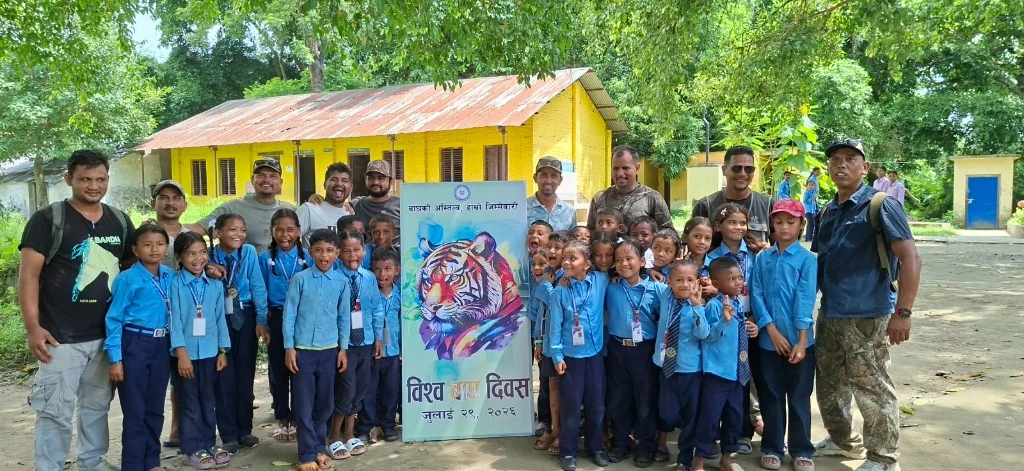
Organize regular awareness programs in surrounding buffer-zone villages about wildlife conservation, biodiversity, environmental protection, and the importance of preserving the national park.
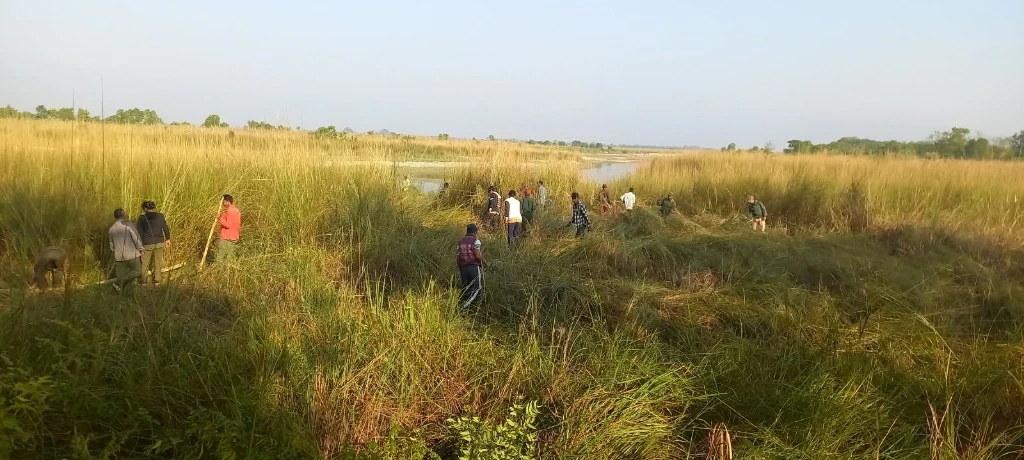
Organize regular cleaning campaigns around the national park, along walking trails, riverbanks, and in surrounding communities.
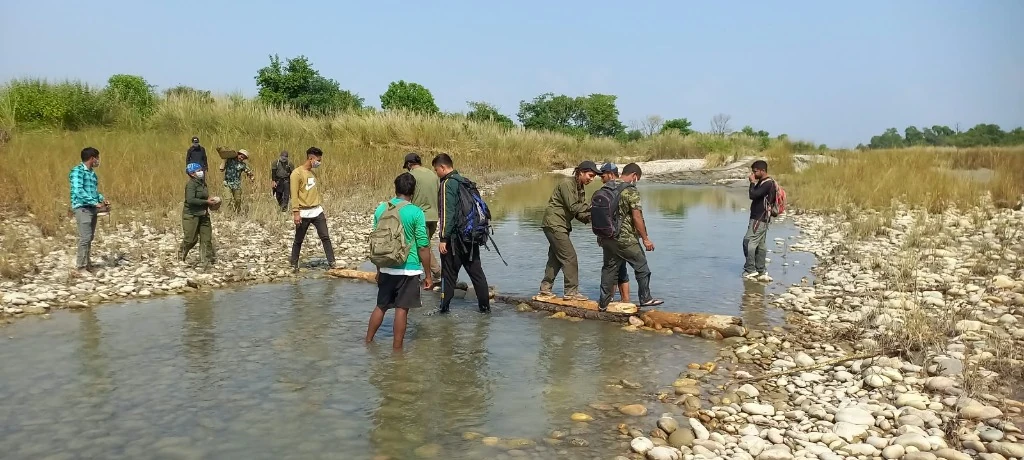
Provide basic training for young and interested local people who want to become nature guides, including wildlife identification, animal behaviour, birdwatching, guiding skills, safety, and visitor management.
Work together with the national park administration to identify, develop, and maintain safe walking trails inside the park for nature lovers and tourists.
Act as a mediator between local communities and park authorities, helping to build better communication, cooperation, mutual understanding, and conflict resolution.
Organize conservation workshops, guided nature walks, and programs that encourage responsible tourism, local participation, and direct economic returns for local families.
“There are several things NaGA do. There are many more possibilities. If the association has a good budget and financial support, it can implement much bigger programs, create opportunities for local people, support conservation, and make a positive impact in the communities surrounding Bardia National Park.”
A progressive, measurable, and transparent roadmap to protect trackers and empower buffer-zone communities:
First, vital and non-negotiable step: establishing comprehensive private hospitalization and accident insurance for all association guides.
100% of NAGA guides under private insurance by 2027
Preserving ancestral tracking heritage and maintaining safe walking corridors inside the park.
15 licensed young guides & 3 trails maintained
Building an active communication bridge between buffer-zone villages and conservation authorities.
12 buffer-zone villages engaged and supported
Achieving self-sustaining financial independence and exporting the tracker safety model across Nepal.
Self-sufficient model replicated across the Terai
Your donation goes directly to the Bardia Nature Guide Association (NAGA). Every dollar or euro collected is tracked and allocated with priority to the vital survival needs of trackers and community coexistence actions in local villages.
Procuring tactical tourniquets, haemostatic pressure dressings, and sterile wound supplies to equip trackers on active patrols.
Building an emergency financial reserve dedicated to immediate evacuation and intensive hospital care in the event of an animal charge.
Funding educational books and materials for wildlife awareness in village schools and organizing community trail trash cleanups.
To guarantee complete financial traceability and eliminate third-party commission fees, donations are transferred directly to the association's official bank account in Nepal, or given in person upon your arrival in Bardia. Contact us to receive the official banking details and associative receipt.
Total transparency: an annual fund allocation report detailing equipment delivered with photographic verification is sent to every contributor.
Whether you represent an environmental grant foundation, a research NGO, a governmental partner, or you are a conscious traveler looking to support direct grassroots impact, we welcome transparent dialogue.
Official authorities & references in Nepal:
Member of Collectif My Way & licensed local tour operator partner
MYWAY SAS
Atout France License: IM059190009 · SIRET 85137544400011
Financial Guarantee: GROUPAMA ASSURANCE-CRÉDIT & CAUTION · Professional Civil Liability: GENERALI IARD.
Robin Rozier / Jungle Nepal Adventure acts as an official business introducer and partner for MYWAY SAS.

Jungle Nepal Adventure Pvt. Ltd.
Registration No: 384414/82/83 · PAN: 623537310
Registered & licensed by the Ministry of Industry and Nepal Tourism Board. Leadership: Pawan Thapa (Lead Tracker) & Kiran Pokhrel.
Robin Rozier — Jungle Nepal Adventure (Sole Proprietorship)
SIRET 91025797100010 · RCS BESANCON
4 rue guy moquet, 66310 Estagel, France · junglenepaladventure@gmail.com
Personalized itinerary, flexible dates, exclusive safaris or custom expeditions. Pawan and Robin craft your journey from A to Z.
Thank you! We have received your request. Robin and our local team will get back to you within 48h with a first detailed proposal and quote.
An error occurred. Please verify your details or contact us directly on WhatsApp.
Direct booking inquiry with Robin and the local team. Quick confirmation within 24h.
Thank you! We have received your expedition booking request. Robin will contact you via Email / WhatsApp within 24h to confirm availability and dates.
An error occurred. Please verify your details or contact us directly on WhatsApp.