📌 Quick Summary: A Day with Native Tharu Trackers in Bardia
- Ancestral Ethology: Tharu master trackers read the jungle like an open book—decoding fresh pugmarks, soil moisture, claw scratches on bark, and complex avian alarm calls.
- Dawn Departure (6:00 AM): Entering the park at first light when nocturnal predators are returning to day hides along the Geruwa and Khauraha riverbeds.
- Midday Riverbank Stakeouts: Setting up silent vantage points under shaded trees overlooking active watering holes during the heat of the day.
- The Bush Lunch: Enjoying hot fresh dahl bhat or parathas in an elevated wooden watchtower (machan) overlooking the grassland savannah.
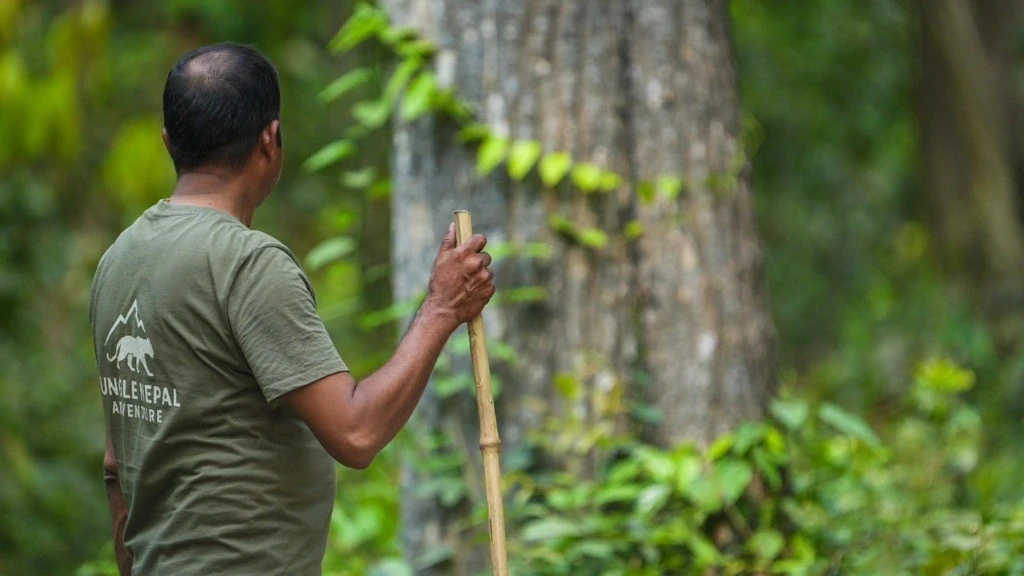
- Two Licensed Guides Required: Every walking safari in Bardia National Park is led by two licensed naturalists carrying traditional bamboo lathis (staffs).
It is 5:45 AM. A diaphanous veil of mist hovers over the sleeping paddies of Thakurdwara. In the courtyard of our eco-lodge, Pawan and Kiran double-check their canteens and shoulder their canvas daypacks. In their hands, you will see no firearms, darts, or spears: only a stout, polished bamboo walking staff (lathi), burnished by decades of intimate jungle travel.
Embarking on a walking safari in Nepal stirs an instinctive blend of awe and heart-pounding respect: is it truly safe to tread on foot across the very realm of a 220 kg Royal Bengal tiger, an armored greater one-horned rhino, or a wild bull elephant?
The answer from experienced naturalists is an emphatic yes—provided you follow the ancestral tracking codes developed across centuries by the indigenous Tharu people. Learn more about our team and heritage in our feature on Tharu culture and jungle life in Bardia.
Bardia Walking Safari (1-Day Tiger Tracking)
€50 / person • 2 certified naturalist guides • Complete safety briefing and silent on-foot immersion.
06:15 AM: Entering the Green Frontier & Safety Briefing
After checking entry permits with the Nepal Army conservation outpost at the park boundary, your shoes touch the first sandy jungle track. Before advancing a single step into the Sal forest canopy, your two guides gather the group for a mandatory safety briefing.
The four golden rules of foot tracking are delivered with quiet authority:
- Absolute silence while moving: Snapping dry twigs, crunching broad Sal leaves, and rustling synthetics are your primary obstacles. A tiger's hearing is five times sharper than a human's; your safety relies on hearing the jungle before it detects you.
- Tight single-file formation: Never wander or fan out. The lead guide navigates the terrain and scans the horizon; the rear guide monitors your backtrail. In the eyes of apex predators, a tight unit presents a formidable collective silhouette, whereas a scattered walker mimics vulnerable prey.
- The bamboo staff (Lathi): More than a hiking pole, this traditional Tharu staff tests river depths, parts thorny wait-a-minute vines silently, and serves as an imposing visual barrier in close encounters.
- The universal rule: NEVER RUN. In the animal kingdom, only prey bolts in panic. Running instantly triggers a predator's innate predatory reflex. For an in-depth safety breakdown, see our guide: Is a walking safari dangerous in Nepal?.
Protocol facing a Bengal Tiger: immediate complete halt. The group stands shoulder-to-shoulder to form a solid wall. Maintain direct, unblinking eye contact without shouting, and retreat step by deliberate step backwards. Never run and never turn your back. In 99% of encounters, the cat assesses the group and melts away silently into the brush. (Learn more: Bengal tiger behavior).
Protocol facing a One-Horned Rhino: if the animal charges, the golden rule is to immediately climb a sturdy tree 2 to 3 meters up following the guides' cues. In open terrain without climbable trees, run in rapid zig-zags to outmaneuver its narrow peripheral vision, or drop a backpack or garment to deflect its charge. (Learn more: one-horned rhino behavior).
Protocol facing a Wild Elephant: anticipation and avoidance override everything. Wild elephants do not tolerate proximity. Trackers detect them early through their pungent musky scent, snapping branches, and ground tremors. Detour immediately downwind at a broad distance (over 300 meters), never blocking their migration corridors to the river. (Learn more: wild elephants in Nepal).
07:30 AM: Reading Pugmarks and Fresh Night Tracks
Early sunbeams filter through the towering canopy of Sal trees (Shorea robusta). The damp sand along an army patrol path reveals secrets carved in darkness.
Pawan drops swiftly to one knee. With calloused fingertips, he gently traces the crisp circumference of a fresh pugmark pressed into the alluvial silt.
- The Tracker's Analysis: The 9.5 cm heel pad width identifies a dominant territorial male. The sand ridges remain moist and dawn dew has not yet settled into the indentations: the tiger passed here less than 45 minutes ago.
- Territorial Markings: A few meters ahead, a stout Sal trunk displays vertical claw gashes over two meters high, accompanied by a musky scent resembling warm buttered popcorn: the cat marked his perimeter before heading down to the water. Master these signs in our field handbook: The Art of Jungle Tracking in Nepal: Tracks, Alarm Calls and Secrets.
09:00 AM: The Alarm Symphony in the Forest Canopy
As we push toward riverine corridors, the forest wakes up. On foot, trackers do not spot predators with their eyes first—they listen with tuned ears:
"Listen to the chital!" whispers Kiran.
Three hundred meters to our flank, the sharp, metallic bark of a spotted deer (Axis axis) pierces the brush. Seconds later, a harsh, guttural cough echoes from the treetops: the alarm call of a dominant Tarai grey langur.
Perched twenty meters high, langurs possess an unhindered vantage over dense elephant grass. Their alarm never lies: a big cat is stalking. Testing wind direction with a pinch of dry dust, our guides steer us with feather-light steps toward a natural gravel ridge overlooking the riverbank.
11:30 AM: Silent River Stakeout Along the Geruwa
During the heat of the day (especially from March to May when midday mercury climbs to 38°C), tigers retreat from sweltering grasslands to soak in refreshing river shallows. Find the best seasons in our report: Tigers in Bardia: Sighting Probabilities and Top Water Spots.
We settle into position on the boulder beaches of Tinkuni, a celebrated three-river junction where braided channels carve quiet pools below clay bluffs:
- We nestle quietly against rounded boulders beneath thorny shade bushes.
- Not a single word is spoken; whispers are replaced by discreet hand gestures.
- For two to three hours, we watch the shimmer of the water. A prehistoric Gharial crocodile drifts past while smooth-coated otters fish playfully.
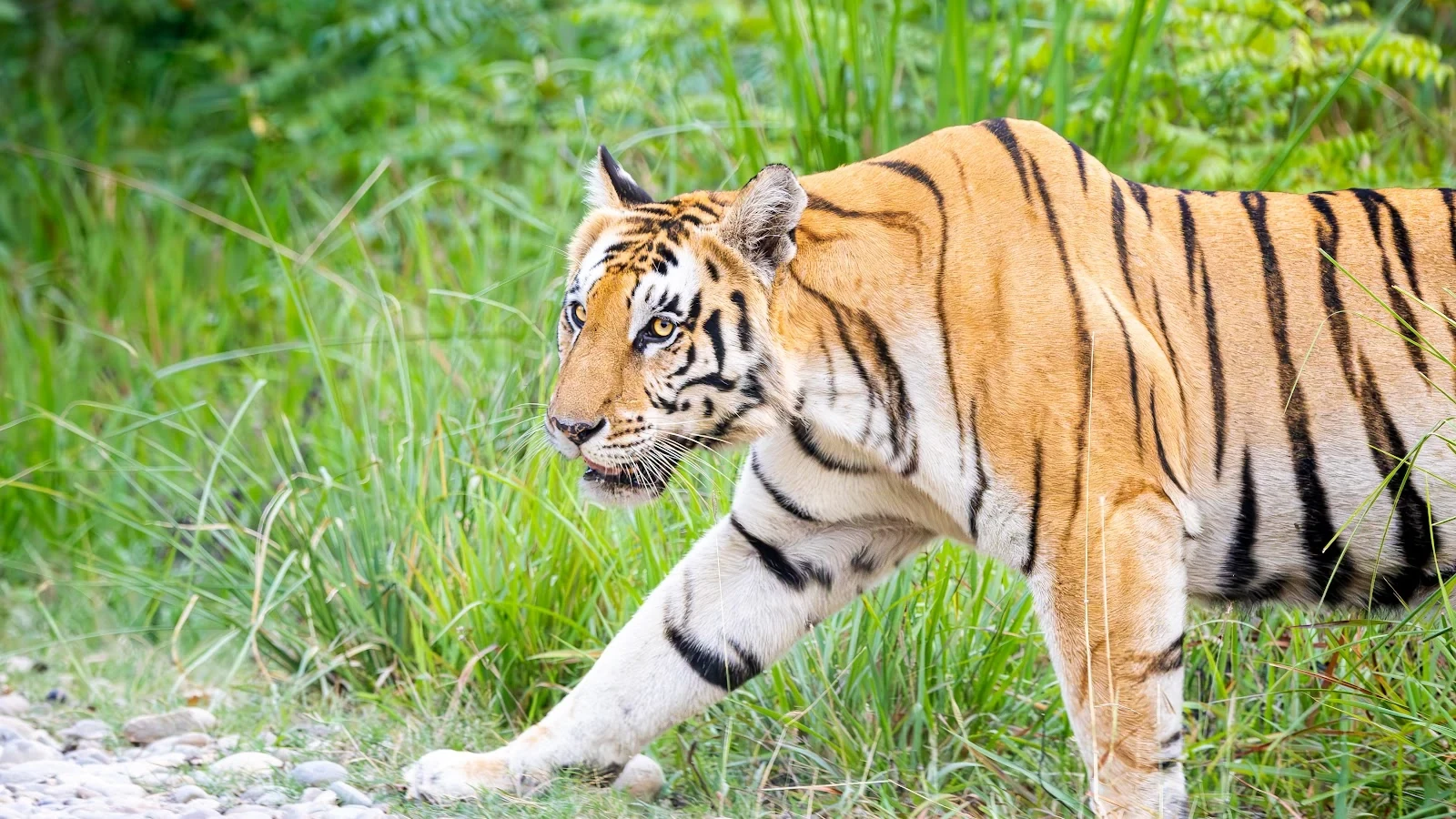
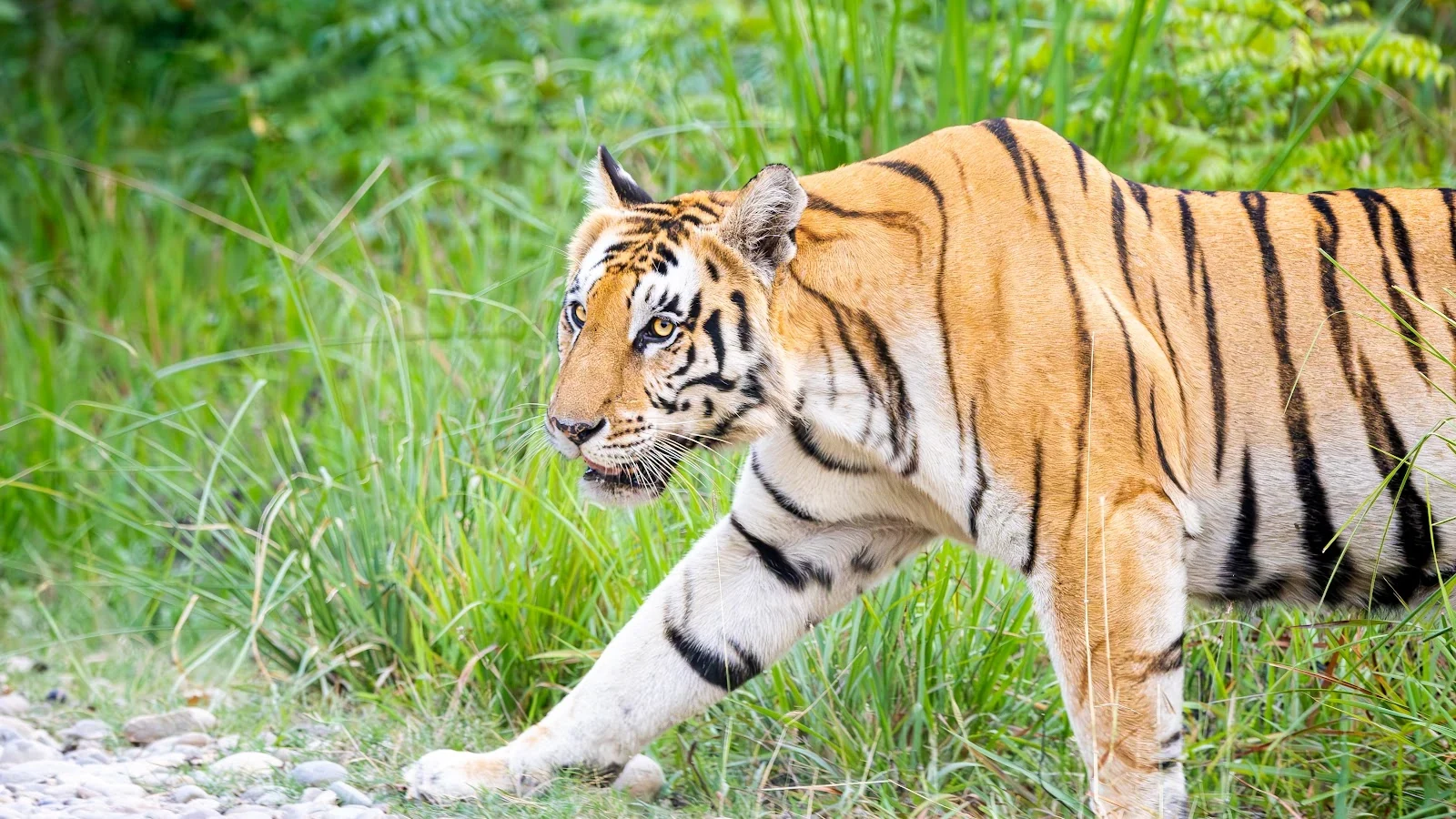
- Suddenly, at the golden fringe of the opposite shore, a radiant orange and black silhouette materializes: the tiger advances with unhurried grace, drinks calmly, and wades in chest-deep. Witnessing this spectacle from ground level, without vehicle windows or metal cages, is an indelible privilege.
02:00 PM: Bush Lunch in a Forest Watchtower (Machan)
Midday rest is spent inside a traditional wooden machan raised six meters off the ground. It is the time to unwind, relish a steaming lunch packed by the lodge (dahl bhat, fresh sautéed vegetables, and fruit), and scan the river flats with binoculars.
04:30 PM: Face-to-Face with an Armored Colossus: The Greater One-Horned Rhino
In the late afternoon, we loop back across floodplain marshlands. The wind shifts. Suddenly, a massive grey boulder seems to rise fifty meters away in a clearing: an immense Greater One-Horned Rhinoceros (Rhinoceros unicornis) grazing on water hyacinths.
Pawan tests the breeze again. It blows toward us—the colossus has not scented our party. Despite feeble eyesight, its ears swivel like acoustic dishes. The guides maneuver our group behind an alignment of sturdy trees. We marvel at the armor-plated skin folds coated in dry mud—a true living prehistoric titan. Browse the full wildlife roster in our guide: Animals of Bardia: Complete Wildlife Guide.
06:30 PM: Lodge Fireplace Debrief
The setting sun paints the Siwalik foothills crimson. We exit the park gates, boots coated in fine dust, senses still tingling.
Around the evening campfire with hot masala chai in hand, Pawan unfolds the topographical map of Bardia. With a marker, we retrace the 14 kilometers walked, three fresh pugmark sets recorded, bird species ticked off, and magical minutes spent watching wild tigers.
Is a Walking Safari Right for You?
Tracking on foot does not require elite marathon fitness: the pace is measured, punctuated by extensive stationary hides. Check our fitness recommendations in: What Fitness Level is Needed for a Walking Safari in Nepal?. If you are wrapping up a Himalayan mountain hike, see our new guide on how to organize a safari in Bardia after trekking.
Far removed from mass tourism, foot tracking is the ultimate gesture of humility and respect one can offer to the wild sovereigns of the Terai.
Experience an authentic walking safari with our Tharu master trackers
Already in Nepal or planning your trip? Join our elite local trackers for a 1-day walking safari or a complete 5-day Bardia wildlife expedition.