

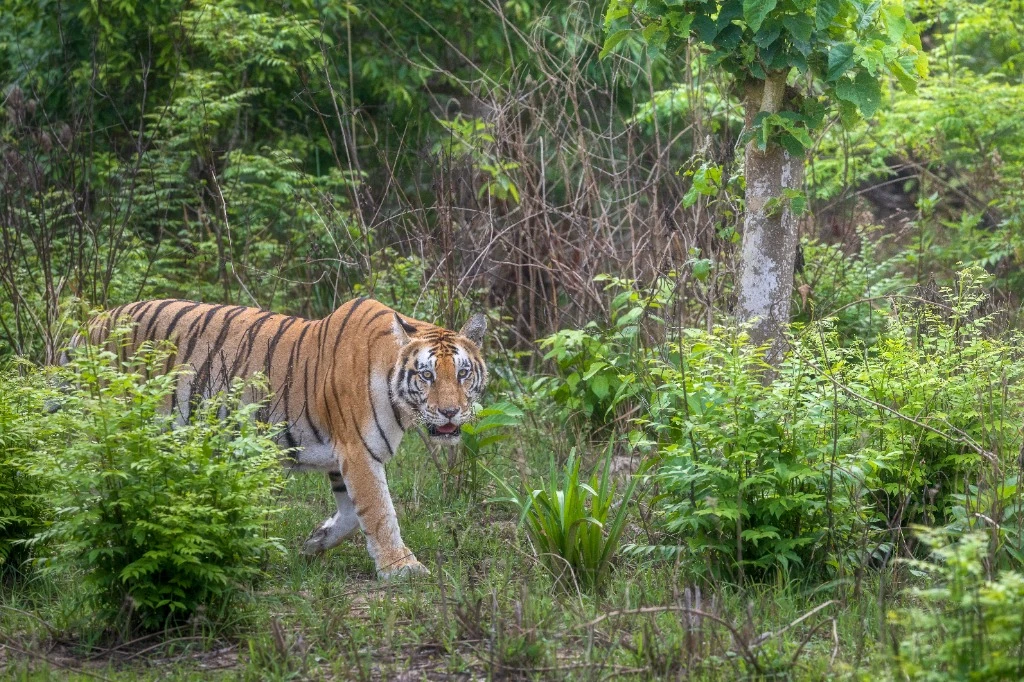
📌 Quick Summary: Walking Safari Safety in Nepal
- Strict Two-Guide Regulation: By national park law in Bardia, entering the wilderness on foot requires two certified government-licensed naturalists at all times.
- The Bamboo Staff: Guides do not carry firearms. They use traditional seasoned bamboo staffs, relying on deep animal ethology, wind orientation, and non-violent deterrence.
- Golden Rule: Never run in front of a predator. Running instinctively triggers the chase response of apex carnivores.
- Dress Code: Neutral earth tones (khaki, olive, beige, dark green). Strict ban on bright colors, white, and scented deodorants or perfumes.
Entering the dense subtropical jungle of Bardia National Park on foot is arguably the most electrifying wildlife encounter on the Asian continent. Yet for first-time visitors, walking through territory ruled by wild Bengal tigers, greater one-horned rhinos, and wild bull elephants naturally sparks legitimate questions about danger and safety. Here is an authentic breakdown of how safety is guaranteed in the field.
1. The Mandatory Two-Tracker Rule: Eyes in Front and Behind
In Bardia, independent walking inside the park is strictly illegal. Every walking safari must be escorted by a minimum of two certified senior guides:
- Lead Tracker: Walks at the head of the single-file line, scanning fresh tracks, reading broken branches, checking wind direction, and observing alarm calls from langurs and chital deer.
- Rear Tracker: Closes the line, ensuring that no guest falls behind and continuously scanning the flanks and rear perimeter. Tigers are stealth ambush hunters that rarely approach from the front; having a dedicated professional guarding the rear eliminates surprise encounters.
- Decades of Indigenous Heritage: Our guides belong predominantly to the indigenous Tharu community. They have lived beside the jungle for generations, possessing an intuitive understanding of animal vocalizations, tail flicks, and body posturing.
2. Why Bamboo Staffs Instead of Firearms?
Many travelers coming from African safaris are surprised to find that Nepalese park rangers and safari guides carry sturdy, fire-hardened bamboo sticks rather than rifles. There are philosophical and practical reasons for this:
- Non-Lethal Conservation Philosophy: National parks in Nepal prioritize strict non-violence. Guides do not enter the wilderness to dominate nature, but to observe as respectful guests.
- The Acoustic Weapon: Striking a hard seasoned bamboo staff firmly against the trunk of a Sal tree produces an echoing, sharp acoustic crack that instantly alarms rhinos and bears, causing them to turn and retreat without physical harm.
- Physical Deterrence: In rare close-quarters encounters with an irritated mother rhino, a firmly planted staff creates a visual and physical barrier that guides use to deflect charges toward nearby trees.
3. Survival Protocols Facing the "Big Four" of the Jungle
Before stepping across the park boundary, your lead guide will deliver an intensive 15-minute tactical briefing covering how to react depending on the species encountered:
| Animal Encountered | Immediate Action | What You Must NEVER Do |
|---|---|---|
| Bengal Tiger | Freeze immediately. Maintain calm, unbroken eye contact. Slowly back away step-by-step behind the guides. | NEVER run or turn your back. Running triggers an instant predatory chase reflex. |
| One-Horned Rhino | Run in a zigzag pattern behind large Sal trees or climb a tree (rhinos cannot climb). Drop your backpack to distract its poor eyesight. | Do not run in a straight line; rhinos charge straight at up to 45 km/h. |
| Sloth Bear | Group closely together with the guides. Wave arms high, bang sticks, and make loud commanding human voices to intimidate it. | Never stay silent or crouch. Sloth bears have poor eyesight and attack out of panic. |
| Wild Asian Elephant | Quietly retreat downwind immediately. Give solitary bull elephants at least 100 meters of clearance. | Never approach upwind or block an elephant's path to water. |
Full-Day Walking Tiger Safari in Bardia (50€)
Experience the ultimate thrill of tracking wild tigers on foot under the safest, most professional conditions in Nepal. Dual licensed trackers, permits, and bush lunch included.
Essential Gear and Etiquette for Walking Safaris
To maximize your safety and avoid spooking sensitive wildlife:
- Footwear: Broken-in lightweight trekking shoes or trail runners with quiet soles. Avoid loud squeaking rubber or heavy mountaineering boots.
- Hydration: At least 2 liters of water in a reusable thermos or canteen (plastic bottles are banned inside the park).
- Silence: Complete discipline. Whispering is reserved exclusively for vital instructions from your lead tracker.
Ready to explore with native master naturalists? Book our Bardia Walking Tiger Safari (from €50) or our Chitwan Rhino Walking Safari (from €70). For complete lodge immersion, discover our Bardia Tiger Safari 5 Days (€690).