
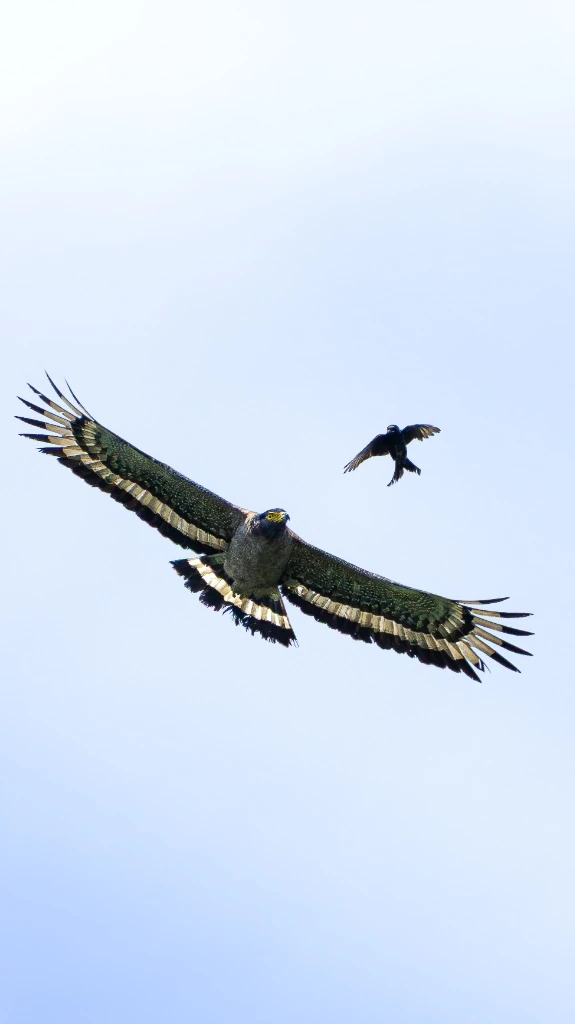
High against the deep blue sky over Bardia's towering Sal canopy, a magnificent raptor with a six-foot wingspan carves effortless circles on thermal updrafts. Lower down, within the shaded branches of a massive silk cotton tree, two piercing golden eyes scan the forest floor for the slightest rustle in the leaf litter. Nepal is not merely the realm of tigers and rhinos: boasting over 880 recorded bird species (nearly 10% of the global total), it represents a world-class sanctuary for diurnal and nocturnal birds of prey.
This comprehensive ornithological field guide explores the anatomy, predatory hunting tactics, prime viewing locations, and the historic conservation resurgence of vultures in Nepal. Learn how to track and photograph the Crested Serpent Eagle, Spotted Owlet, Grey-headed Fish Eagle, Changeable Hawk-Eagle, and the formidable Spot-bellied Eagle-Owl during a dedicated birding safari in Bardia, Chitwan, and Koshi Tappu.
1. Raptorial Habitats & Avian Diversity Across Nepal's Terai Lowlands
Nepal's extraordinary vertical gradient—elevating from just 60 meters above sea level in the southern plains to the 8,848-meter summit of Mount Everest—creates microclimates ideally suited for raptor specialization. Across lowland reserves like Bardia, Chitwan, and Koshi Tappu Wildlife Reserve, birds of prey occupy three distinct biomes:
1. The Dense Subtropical Sal Canopy (Shorea robusta)
Characterized by thick evergreen canopies, this forest environment demands agile woodland hunters with broad, rounded wings and elongated steering tails:
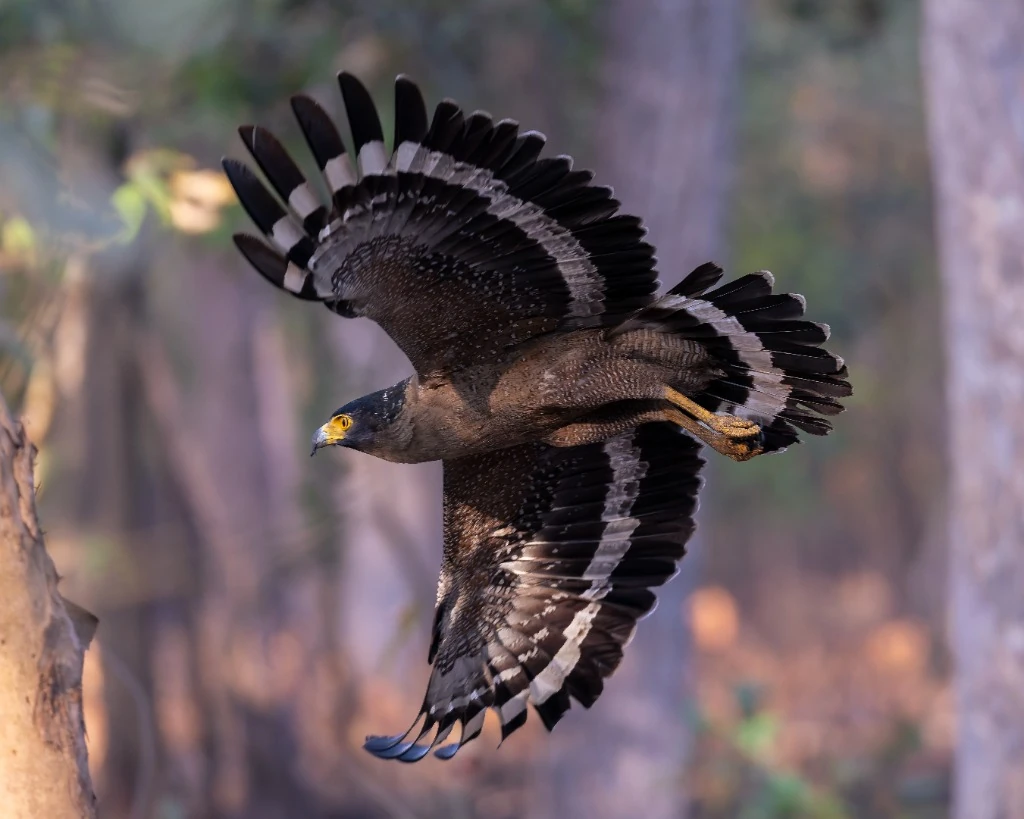
- Crested Serpent Eagle (Spilornis cheela): Distinguished by an erectile black-and-white crest, intense lemon-yellow iris, and bare yellow facial skin. An apex reptile predator, it snatches tree vipers, bronzebacks, monitor lizards, and tree frogs with surgical precision.
- Changeable Hawk-Eagle (Nisaetus cirrhatus): A powerful woodland eagle bearing an elegant black crown crest. It swoops downward at explosive speed to seize juvenile langurs, giant flying squirrels, and Kalij pheasants.
- Crested Goshawk (Accipiter trivirgatus): A compact, ultra-maneuverable forest accipiter capable of intercepting small forest passerines mid-air through dense tangled vines.
2. Riverine Networks & Riparian Corridors (Karnali, Rapti, Babai)
Clean alluvial river systems support prominent fish-hunting raptors:
- Grey-headed Fish Eagle (Ichthyophaga ichthyaetus): Standing over 28 inches tall with a slate-grey cowl and pristine white belly, its talons feature specialized rough plantar spicules that maintain a vice-like grip on slippery river carp (Golden Mahseer).
- Western Osprey (Pandion haliaetus): A winter migrant that plunges completely below the water's surface, shaking river spray from its plumage as it re-emerges clutching live fish.
3. Expansive Alluvial Floodplain Savannas
In the vast tall grass savannas of Suklaphanta and Bardia glide specialized harriers and eagles: the Pallid Harrier, Western Marsh Harrier, and vulnerable Greater Spotted Eagle hunting rodents and small ground birds.
Field Identification Matrix: Premier Raptors of Nepal
| Species (Scientific Name) | Wingspan & Diagnostic Silhouette | Diet & Hunting Specialization | Prime Observation Hotspot |
|---|---|---|---|
| Crested Serpent Eagle (Spilornis cheela) | 120-150 cm, rounded wings, wide white tail band | Snakes, lizards, amphibians • Canopy ambush | Bardia & Chitwan Sal forests |
| Grey-headed Fish Eagle (Ichthyophaga ichthyaetus) | 160-180 cm, grey cowl, pure white lower abdomen | Piscivore • Surface diving with specialized spicule talons | Rapti and Karnali river channels |
| Spotted Owlet (Athene brama) | 45-55 cm, small compact owl with speckled plumage | Beetles, moths, small rodents • Crepuscular forager | Tree hollows near traditional Tharu villages |
| Spot-bellied Eagle-Owl (Bubo nipalensis) | 140-165 cm, large horizontal ear tufts, huge talons | Pheasants, hares, young muntjac • Apex nocturnal hunter | Secluded Babai Valley in Bardia |
| White-rumped Vulture (Gyps bengalensis) | 200-225 cm, brilliant white back rump in flight | Obligate scavenger • Critical ecosystem sanitary cleaner | Community Vulture Safe Zones |
2. Nocturnal Raptors: The Phantom Hunters of the Terai Night
When dusk settles across the Siwalik foothills, a nocturnal acoustic drama unfolds across the jungle:
The Spotted Owlet (Athene brama)
Measuring roughly 8 inches, this charismatic small owl with large golden round eyes roosts inside cavities of ancient mango trees and village thatch eaves. Highly active during late afternoon, it bobs its head up and down to calculate prey distance before emitting musical chattering calls.
The Spot-bellied Eagle-Owl (Bubo nipalensis)
Also known as the Forest Eagle-Owl, this formidable predator possesses prominent slanted ear tufts and colossal talons capable of taking down adult peafowl and barking deer. Its eerie, guttural call resembling a human groan has earned it the folklore name of Devil Bird (Hutityau) in rural Nepal.
Spot Rare Raptors and Birds of Prey in Nepal
Specialized birdwatching itineraries equipped with spotting scopes and led by expert ornithologists.
3. The Asian Vulture Conservation Miracle in Nepal
During the 1990s and early 2000s, South Asia suffered the most catastrophic avian population crash in modern history: over 99% of vulture populations (including White-rumped and Slender-billed Vultures) collapsed due to secondary poisoning from the veterinary drug diclofenac, which caused fatal kidney failure in scavenging birds.
The Pioneering Solution: Community "Vulture Restaurants"
Nepal pioneered a world-renowned grassroots conservation strategy:
- Total Diclofenac Ban: In 2006, the Nepalese government banned veterinary diclofenac, promoting the safe alternative meloxicam.
- Vulture Safe Zones & Community Feeding Sites: Local community cooperatives manage sanctuaries where elderly cattle live out their natural lives. After dying naturally without pharmaceuticals, safe carcasses are provided to wild vultures at monitored feeding stations.
Spearheaded by WWF Nepal and Bird Conservation Nepal (BCN), Nepal's vulture populations became the first in Asia to stabilize and show continuous annual growth.
4. Bird Photography Techniques and Telephoto Setup
- Birds In Flight (BIF) Camera Configuration: Set Continuous AF with animal eye-detection. Keep shutter speeds at a minimum of 1/2500s to 1/3200s to freeze primary wing feathers during steep dives.
- Exposure Compensation on Bright Skies: When metering an eagle flying against an overcast or bright sky, dial in +1.0 to +1.7 EV exposure compensation to prevent the bird's underwing plumage from turning into a dark silhouette.
5. Avian Ethology: Aerodynamic Mastery and Raptorial Vision
Observing raptors in the Terai reveals extraordinary evolutionary adaptations. While forest mammals depend heavily on olfaction, birds of prey hunt almost exclusively via phenomenal visual acuity, estimated to be eight to ten times sharper than human eyesight.
A raptor's retina features two distinct foveae (areas of ultra-dense photoreceptor packing): a central fovial pit for monocular panoramic scanning and a temporal fovea that provides stereoscopic binocular depth perception. This allows a soaring Changeable Hawk-Eagle cruising at 1,000 feet to spot a small forest lizard rustling in dry leaf litter and calculate its exact trajectory before executing a near-vertical terminal dive.
6. Nepal's Premier Birdwatching Hotspots and Itineraries
- Bardia National Park (Karnali River & Babai Valley): Over 400 recorded species. Premier reserve for rare canopy eagles, forest owls, and fish eagles.
- Koshi Tappu Wildlife Reserve: Located in eastern Nepal, this Ramsar wetland site is the undisputed national capital for migratory waterfowl, harriers, ospreys, and falcons.
- Chitwan National Park: Benchmark destination for community Vulture Safe Zones and effortless riverbank raptor photography along the Rapti River.
7. Professional Optics and Gear Checklist for Avian Safaris
- 8x42 or 10x42 Roof-Prism Binoculars: Fully multi-coated lenses with nitrogen-purged waterproof housing to eliminate morning condensation.
- 20-60x80 Spotting Scope on Carbon-Fiber Tripod: Essential for scrutinizing perched raptors across wide riverbeds and broad sandbars.
- Field Identification Handbook: The authoritative Birds of Nepal by Richard Grimmett and Carol Inskipp.
8. Detailed Night Owl and Owlet Guide of the Terai
Discovering nocturnal raptors in Nepal requires keen acoustic tracking at dusk. Key species tracked during our guided naturalist night walks include:
- Spot-bellied Eagle-Owl (Bubo nipalensis): Tracked around the deep rocky ravines of the Babai Valley via its resonant, deep guttural booming notes.
- Oriental Scops Owl (Otus sunia): A tiny, beautifully camouflaged owl nesting in hollow trunks of mature silk cotton trees, emitting melodic, whistling three-note territorial calls.
- Spotted Wood Owl (Strix seloputo): An elusive inhabitant of ancient riparian forests, featuring a round chocolate-brown facial disc and delicate barred breast plumage.
9. Premier Raptor Observation Hides & Watchtowers
- Chisapani Gorge Overlook (Karnali River): Superb vantage point for photographing diving fish eagles against dramatic rocky canyon backdrops.
- Kasara Oxbow Wetland Hide (Chitwan): Iconic wetland location for close-range photography of Grey-headed Fish Eagles and Western Ospreys diving for carp.
- Baghaura Grassland Edge (Bardia): Ideal for approaching Crested Serpent Eagles perched low on open branches scanning for basking lizards.
10. Winter Peregrine Falcons and High-Speed Aerial Hunters
During winter months, the braided river corridors of Bardia and Koshi Tappu host wintering Peregrine Falcons (Falco peregrinus) migrating from high Himalayan cliff faces. Executing vertical hunting stoops at speeds exceeding 300 km/h (185 mph) to strike wintering teals and ducks mid-air, the peregrine delivers breathtaking aerial spectacles.
11. Nesting Site Conservation for Ancient Raptor Lineages
Fish eagles and serpent eagles reuse the same massive stick nests built atop colossal silk cotton trees (Bombax ceiba) for decades. Community buffer zone guardians monitor these active nesting sites, ensuring complete acoustic and physical protection during the sensitive chick-rearing period between December and April.
12. Extended Avian FAQ
What is the rarest bird of prey in Nepal?
The Slender-billed Vulture and Red-headed Vulture are among the rarest breeding raptors in Nepal, closely monitored in protected Vulture Safe Zones in Western Nepal.
Can I bring a camera drone to film eagles in national parks?
No. Drones are strictly banned in all national parks across Nepal by the DNPWC and Nepal Army to protect wild wildlife and birds from acoustic disturbance and territorial stress.
Frequently Asked Questions (FAQ) — Birds of Prey in Nepal
When is the best season for birdwatching in Nepal?
November through March is prime. Resident tropical species are joined by hundreds of thousands of winter migrants from Siberia, Central Asia, and the high Tibetan Plateau.
Can we see the Bearded Vulture (Lammergeier) in the Terai lowlands?
No. The Bearded Vulture (Gypaetus barbatus) is a high-altitude Himalayan specialist inhabiting elevations above 2,500 meters. Lowland parks host tropical fish eagles, serpent eagles, and forest owls.
Do naturalist guides supply professional optical gear?
Yes. Our ornithological field guides provide premium Swarovski and Zeiss spotting scopes alongside standard field identification handbooks (Birds of Nepal by Grimmett & Inskipp).
Explore our specialized avian itineraries with the Bardia Wilderness Safari or check out our complete Nepal Birdwatching Guide.
13. Annual Avian Migration Corridors Across the Trans-Himalayan Flyway
Nepal sits directly along the Central Asian Flyway, one of the world's most critical high-altitude migratory routes. As Siberian wetlands freeze over in October, raptors cross the colossal mountain wall of the Himalayas through deep river valleys (such as the Kali Gandaki and Karnali gorges) to reach the fertile hunting grounds of the Terai lowlands. Watching Steppe Eagles and Imperial Eagles glide effortlessly past towering 8,000-meter peaks before descending into the warm subtropical grasslands of Bardia is an awe-inspiring natural wonder.
14. Avian Acoustic Field Identification and Soundscapes
Birdwatching in the dense Sal forests of Chitwan and Bardia is largely an acoustic art. Senior ornithologists rely on distinct vocal signatures to locate hidden forest raptors before catching fleeting glimpses through the leafy canopy:
- Crested Serpent Eagle: Emits a melodious, rising and falling double whistle: "Klu-weeeep... klu-weeeep", delivered from high thermals during morning soaring flights.
- Collared Falconet (Microhierax caerulescens): The world's smallest raptor (barely the size of a sparrow), found in open Sal clearings, produces high-pitched chattering trills while hawking dragonflies and cicadas from high dead snags.
- Grey-headed Fish Eagle: A resonant, laughing, yelping call that reverberates across river channels at dawn, signaling territorial boundaries to rival pairs.
15. Specialized Optical Gear Rentals and Field Assistance
For traveling photographers and birdwatchers who prefer not to transport heavy optics on international flights, Jungle Nepal Adventure maintains an inventory of professional telephoto lenses (Sony FE 200-600mm, Canon RF 100-500mm, and Nikon Z 180-600mm) and high-end Swarovski spotting scopes available for rental at our Bardia and Chitwan base lodges, accompanied by professional carbon-fiber fluid head tripods.
16. Avian Sound Recording and Acoustic Ecology in Nepal
For audio recordists and wildlife sound engineers, the dawn chorus across Chitwan and Bardia offers an immaculate acoustic tapestry free of urban interference. Using parabolic microphones and directional shotgun capsules, field researchers document the calls of rare owls, nightjars, and eagles, contributing to the global xeno-canto avian bioacoustic archive.