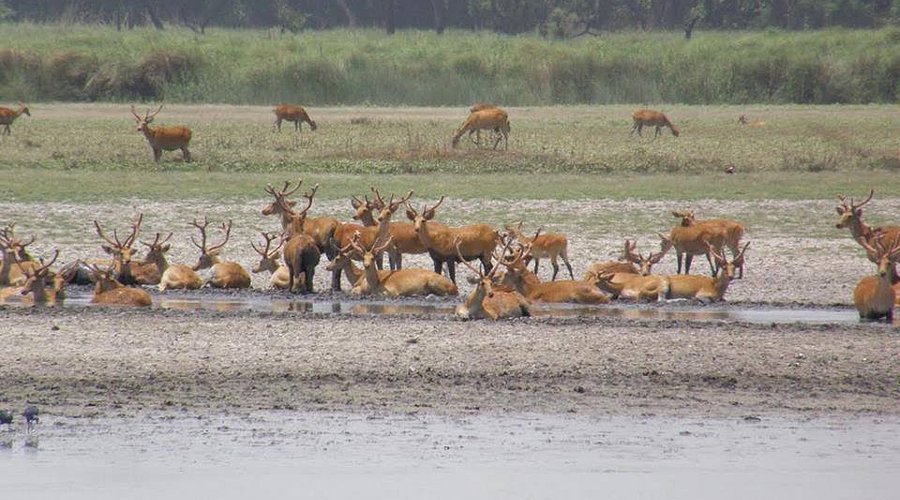

Across the golden savannas and open dry woodland fringes of Bardia and Suklaphanta, a colossal, horse-like silhouette emerges through towering elephant grass: the Nilgai (Boselaphus tragocamelus), or "blue bull", the largest antelope species on the Asian continent. Alongside the majestic Sambar deer, the graceful spotted Chital (axis deer), the secretive Hog deer, and the vocal Barking deer (Muntjac), wild ungulates form the ecological foundation of Nepal's Terai lowlands. Without this flourishing biomass of forest herbivores, the survival of the Royal Bengal Tiger and Indian Leopard would be mathematically impossible.
This comprehensive wildlife biology and tracking guide covers the anatomy, anti-predator vigilance, habitat preferences, and spoor identification of Nepal's wild ungulates during an authentic walking or vehicle safari in Bardia, Suklaphanta, and Chitwan National Parks.
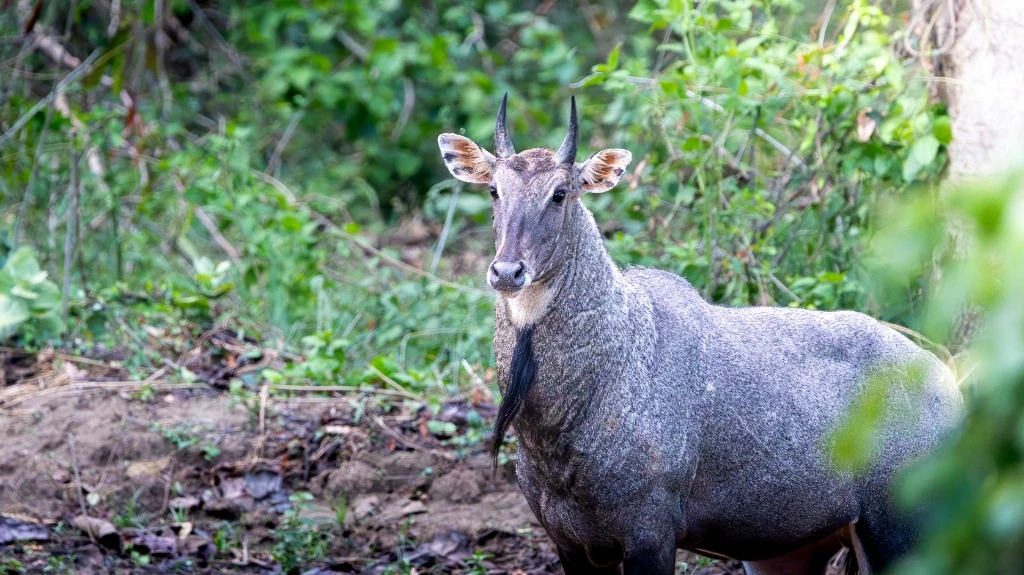
1. The Nilgai (Boselaphus tragocamelus): The Colossus of the Dry Scrublands
The Nilgai is a singular antelope belonging to the ancient, monotypic genus Boselaphus. It exhibits profound sexual dimorphism that continually captivates safari travelers:
Morphology and Sexual Dimorphism
Mature bulls can tip the scales at 240 to 300 kilograms (530 to 660 lbs), standing nearly 5 feet at the shoulder. They boast a deep, steely blue-grey coat (giving rise to their name in Nepali and Hindi: Nil = blue, Gai = cow/bull), a pair of sharp, conical upward-pointing horns (6 to 10 inches), a rigid dorsal neck mane, and a distinctive black throat pendant. Females are noticeably smaller (150 to 200 kg), hornless, and display a sandy, tawny-brown coat suited for arid camouflage.
Superb Drought and Dehydration Resistance
While deer species require daily visits to riverbanks and perennial waterholes, the Nilgai is physiologically equipped for dry woodland savannas. Highly efficient osmoregulatory kidneys allow it to endure days without standing water, extracting metabolic moisture from succulent wild jujube leaves (Ziziphus mauritiana) and dry acacia pods.
2. Nepal's Four Forest Deer: The Prey Base of the Apex Predators
Across southern Nepal's protected river valleys, four cervid species partition the ecological niche with remarkable precision:
1. Sambar Deer (Rusa unicolor): The Solitary Forest Titan
The Sambar is Asia's largest deer, with heavyweight stags exceeding 350 kg (770 lbs). Featuring coarse dark-brown coats and heavy, three-tined antlers over three feet in length, it is a solitary, largely nocturnal woodland browser. Sambar constitute the premier prey selection for large male Bengal tigers in Bardia—a single kill sustaining an apex cat for nearly a week.
2. Spotted Deer or Chital (Axis axis): Gregarious Golden Grazers
Regarded as the most visually stunning deer in the world with bright golden-rufous coats marked with permanent white rosettes, Chital live in vibrant herds of 20 to over 100 individuals. They graze in alluvial clearings and maintain their celebrated mutualistic alarm system alongside Hanuman langurs.
3. Hog Deer (Axis porcinus): The Low-Rider of the Floodplains
Weighing 30 to 50 kg, the Hog deer earns its common name from its unique fleeing gait: rather than leaping over obstacles, it runs with head lowered, ducking beneath dense mats of tall elephant grass like a wild pig.
4. Indian Muntjac or Barking Deer (Muntiacus muntjak): The Ancient Forest Alarm
Weighing only 15 to 25 kg, this primitive solitary deer features elongated upper canine tusks in males and short antlers on skin-covered bony pedicels. Its loud, resonant canine-like bark is the first auditory warning that a tiger or leopard is stalking through the forest within a 300-meter radius.
Comparative Ungulate Matrix: Species of the Terai
| Species | Adult Male Weight | Preferred Micro-Habitat | Social Structure & Ecological Role |
|---|---|---|---|
| Nilgai (Boselaphus tragocamelus) | 240 to 300 kg | Dry scrub, open savanna, Sal ecotones | Small unisex bands, drought-hardy browser |
| Sambar (Rusa unicolor) | 250 to 350 kg | Deep Sal forests, Siwalik hill valleys | Solitary, nocturnal, core prey for tigers |
| Spotted Deer (Axis axis) | 60 to 85 kg | Grassland clearings, riverbanks | Large herds, mutualistic sentinel with langurs |
| Hog Deer (Axis porcinus) | 30 to 50 kg | Swampy tall-grass floodplains | Solitary or pairs, low-profile grass runner |
| Barking Deer (Muntiacus muntjak) | 15 to 25 kg | Dense evergreen ravines, thickets | Solitary, primitive tusks, acoustic tiger alarm |
3. Social Ethology & Nilgai Dung Midden Communications
Nilgai exhibit a unique social communication behavior: the formation of communal dung middens. Resident dominant bulls repeatedly deposit droppings in circular heaps exceeding three feet across along regular travel corridors.
By sniffing these scent posts, rival bulls gauge the physical fitness and hormonal dominance of the territory holder, reducing unnecessary violent combat. When rival bulls do fight for mating rights, they engage in a distinctive ritual: dropping onto their front knees, they push neck-to-neck in a powerful wrestling trial of sheer mass.
Explore the Wild Floodplains and Grasslands of the Terai
Walking safaris tracking wild ungulates, deer herds, and apex predators in Nepal.
4. Field Spoor & Hoofprint Identification Guide
- Nilgai Hoofprint: Large, sharply pointed cleits (4 to 5.5 inches long), noticeably narrower and more angular than domestic cattle tracks, showing a distinct splay.
- Sambar Track: Heavy, broad, rounded hoof impression (3.5 to 4.5 inches), pressing deeply into forest soil due to massive body weight.
- Chital Hoofprint: Slender, elegant prints (1.5 to 2.5 inches), moving in tight parallel lines that reflect light, bounding travel.
- Muntjac Track: Minute, delicate impressions barely 1 inch in length, frequently accompanied by disturbed leaf mulch where the deer nuzzled for fallen berries.
5. Wildlife Photography Masterclass for Lowland Herbivores
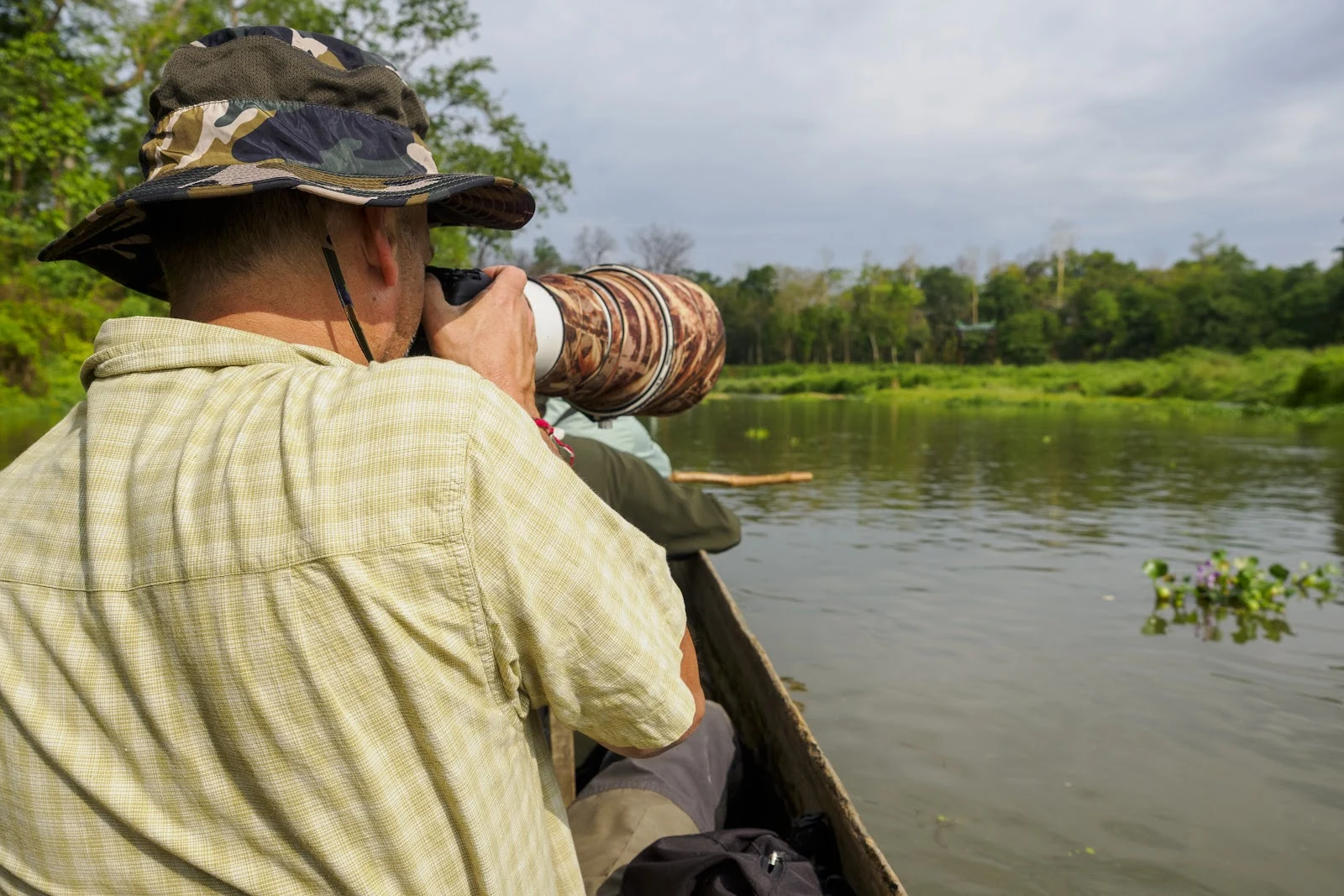
- Lens Selection: A 200-600mm or fast 400mm telephoto lens cleanly separates browsing Nilgai or Sambar stags from complex tall-grass backgrounds.
- Rutting Behavior: In early spring (March-April), capture dramatic antler sparring between Chital stags or mating displays in open clearings.
- Golden Hour Compositions: As herds emerge from dense Sal thickets onto open floodplains around 4:30 PM, the low sun illuminates golden coat tones and dust kicked up by galloping herds.
6. Predator-Prey Dynamics: Biomass Ratios and Prey Selection
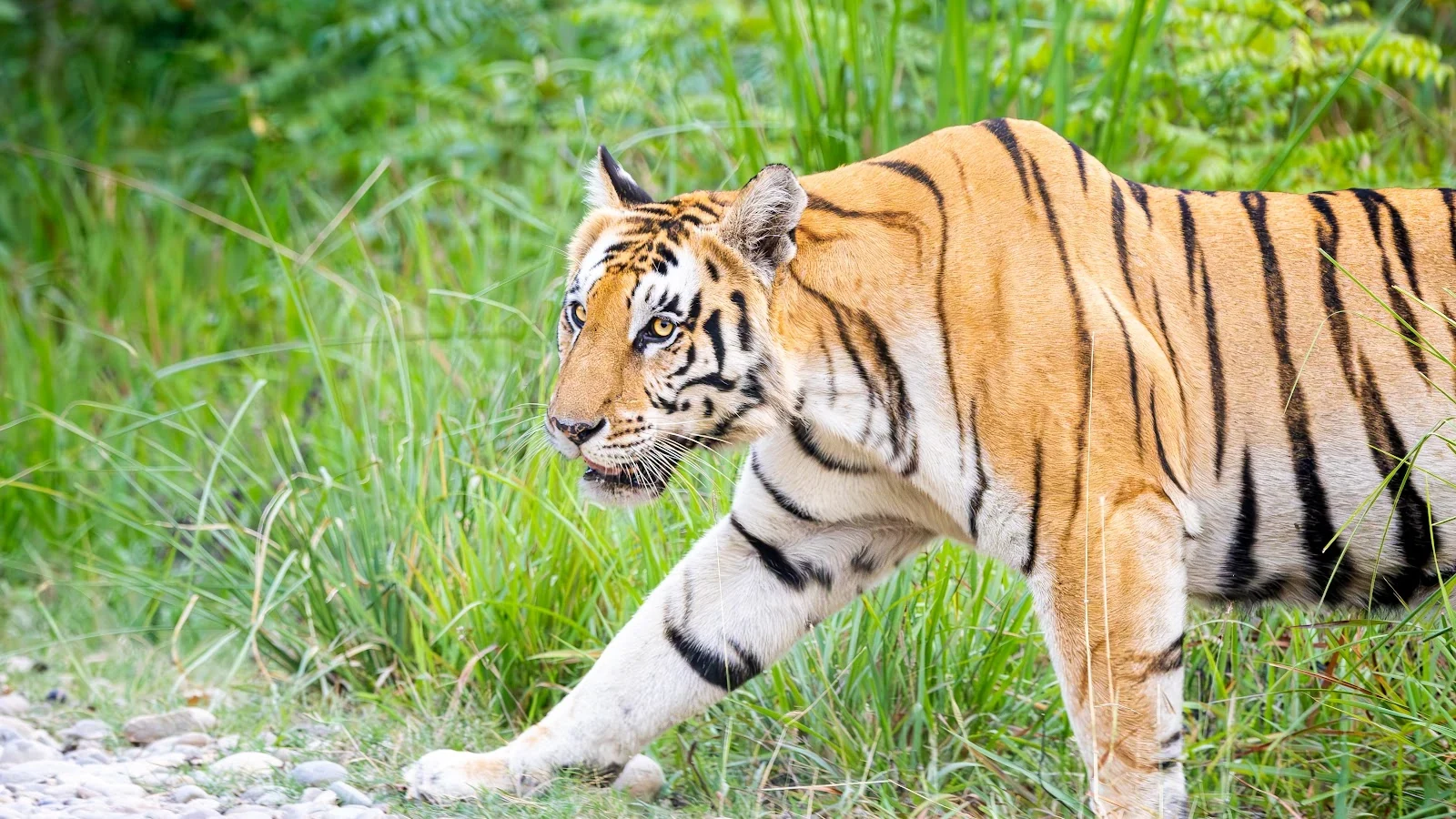
The balance between wild ungulates and apex carnivores in the Terai operates under strict energetic principles. An adult male Royal Bengal Tiger (weighing between 200 and 260 kg) requires the equivalent of one large ungulate (Sambar or Nilgai) every 6 to 8 days, totaling roughly 50 substantial kills annually.
Tigers preferentially select large adult sambar and nilgai due to the enormous caloric return they provide, despite the physical risk posed by defensive flailing hooves and heavy horns. Conversely, for tigresses rearing young cubs or solitary leopards (50 to 70 kg), medium-sized chital and hog deer represent the optimal prey: easily overpowered, swiftly dispatched, and dragged into dense thorny undergrowth away from scavengers.
7. Seasonal Floodplain Dynamics (The Phantas of Nepal)
The Phantas (expansive open alluvium grasslands created by historical river shifts and village resettlements) represent the biological engine of Bardia and Suklaphanta:
- Controlled Grass Harvesting and Winter Burns (January-February): Park management permits regulated local thatch cutting followed by controlled mosaic burns. This stimulates rapid regeneration of succulent high-protein grass shoots that draw thousands of browsing ungulates into open sightlines.
- Pre-Monsoon Convergence (March to May): As minor forest pools evaporate under the summer sun, deer and antelope herds concentrate in staggering numbers around perennial riverbanks, creating world-class game-viewing opportunities.
8. Ungulate Anti-Predator Defense Comparison Table
| Ungulate Species | Sprint Speed & Stamina | Primary Defense Weapon | Escape Strategy |
|---|---|---|---|
| Nilgai | 55 km/h • Exceptional distance stamina | Sharp conical horns, powerful hoof kicks | Long-distance sustained sprint across open plains |
| Sambar Deer | 45 km/h • Powerful hill climber | Three-foot heavy beam antlers, aggressive charge | Retreating into deep river pools or steep ravines |
| Spotted Deer | 65 km/h • Ultra-agile leaping speed | Herd confusion effect, communal vigilance | High-bounding zigzag flight with alarm barks |
9. Antler Regeneration Biology in Sambar and Spotted Deer
The annual cycle of antler casting and rapid regeneration among Nepal's cervids is a biological marvel. Following the annual rut, dropping testosterone levels cause the heavy bony antlers to shed cleanly from the cranial pedicels.
Over the following four months, new antlers grow under a rich sheath of velvet skin packed with blood vessels and neural networks, growing at speeds exceeding one centimeter per day. Once fully mineralized into solid dense bone, stags vigorously scrape their antlers against rough Sal tree trunks to strip away the dried velvet sheath and polish their tines for the autumn rut.
10. Safety Protocols When Tracking Large Herbivores on Foot
- Maintain a 20-Meter Buffer: Though wild herbivores naturally retreat, a cornered 300 kg Nilgai bull or Sambar stag can execute powerful defensive charges.
- Never Intercept a Doe and Her Fawn: Sambar mothers defend newborns with formidable courage, using sharp front hooves capable of fracturing a predator's ribs.
11. Extended Ungulate Field FAQ
What is the difference between an antelope (Nilgai) and a deer (Sambar)?
Antelopes have permanent, unbranched hollow horns made of keratin over a bone core that are never shed. Deer possess branched, solid bone antlers that are cast and regrown annually.
Are spotted deer active during midday heat?
During the hot hours between 11:30 AM and 3:30 PM, herds retreat into deep shaded Sal groves to ruminate peacefully, emerging onto open grasslands in late afternoon.
Frequently Asked Questions (FAQ) — Nilgai & Deer of Nepal
Why is the Nilgai called a "Blue Bull" if it is an antelope?
Mature male bulls develop a distinctive slate-blue sheen across their coats in direct sunlight, and their muscular shoulder hump resembles bovine cattle. Taxonomically, they belong to the family Bovidae and subfamily Bovinae.
Does religious reverence protect Nilgai in Nepal?
Yes. Because the name contains Gai (the sacred cow in Hinduism), local communities historically afforded the Nilgai traditional spiritual protection from hunting.
Which park offers the highest density of Nilgai in Nepal?
Bardia National Park (specifically Baghaura Phanta) and Suklaphanta National Park support the country's healthiest and most visible Nilgai populations.
To experience these open savannas and track grand herbivores, explore our Bardia Wilderness Explorer Tour or read our Suklaphanta Destination Guide.
12. Solar-Powered Waterholes and Ungulate Climate Resilience
To mitigate prolonged dry seasons exacerbated by climate variability, national park authorities in Bardia and Suklaphanta constructed ecological solar-powered waterholes throughout dry grassland sectors. Fed by deep groundwater aquifers, these permanent watering basins provide a dependable hydration source for browsing herds of Nilgai, Sambar, and Chital.
By preventing wildlife from venturing outside protected boundaries into adjacent village irrigation canals, these strategic interventions decisively lower human-wildlife friction while providing travelers with spectacular wildlife blind viewing opportunities during the peak dry months from March to May.
13. Ambush Predation Dynamics and Herbivore Vigilance Loops
To successfully capture alert ungulates like Chital or Nilgai, apex predators must execute flawless stalk sequences. A Bengal tiger's vertical black stripes disrupt its outline against tall dry grasslands (disruptive camouflage), allowing it to crawl belly-to-ground within 40 feet of browsing prey before launching an explosive terminal sprint in under three seconds.
To survive, ungulate herds maintain synchronized vigilance loops: while several individuals graze with lowered heads, designated sentries remain upright, sweeping the wind with flared nostrils to catch the faintest scent traces of approaching predators.
14. Wildlife Population Census and Habitat Restoration Programs
Under the stewardship of the Department of National Parks and Wildlife Conservation (DNPWC) and the National Trust for Nature Conservation (NTNC), annual camera-trap surveys and line-transect counts closely monitor ungulate population densities across Bardia and Suklaphanta. Habitat management programs actively remove invasive alien weeds (such as Mikania micrantha and Lantana camara) to preserve native grassland biodiversity and sustain the prey base required for expanding tiger populations.
15. Nutritional Mineral Licks and Mud Basking Ecology
During the intense heat of pre-monsoon spring, wild ungulates gather around natural subterranean mineral salt licks (known locally as Nun-Kharka). Sambar stags, Nilgai bulls, and Chital does consume mineral-rich clay deposits packed with calcium, magnesium, and essential trace elements required for vigorous antler mineralization and lactation support.
16. Ethological Herd Communication via Chemical Scent Marking
In addition to vocal barks and visual tail flagging, wild cervids like Sambar and Chital rely on preorbital scent glands located in front of the eyes. Stags vigorously rub these glands against tree saplings to deposit territorial pheromones, delineating core mating zones across the riverine woodlands.